
Every morning at midnight UTC, a new murder appears. You have a deduction grid—four suspects, four weapons, four locations—and a handful of clues. You have no timer. You have no hints (unless you ask for one). You have logic. The narration is a gift: twelve seconds of hardboiled detective voice that sets the mood before you ever touch the grid. No ads interrupt your solve. No subscription renews without asking. When you close the case, you share an emoji-grid of your work—your friends see how you got there, not who the killer was. Then you wait until tomorrow.
The mechanic: constraint satisfaction dressed in noir
Casefile Daily is built on a deduction grid—the same logic puzzle type that powers Murdle and the NYT's occasional Friday-afternoon brainteaser. A 4×4 grid represents all possible combinations: each of four suspects pairs with each of four weapons and four locations. Your job is to mark the grid using clues, narrowing possibilities until exactly one solution remains. Every case is verified to have exactly one valid answer. If you've followed the logic correctly, you cannot be wrong by accident.
The puzzle itself is timeless—it's the same constraint-satisfaction problem that has appeared in puzzle books for fifty years. What makes Casefile Daily different is the wrapper: before you see a single cell, you hear the case. A detective's voice, low and world-weary, tells you something. Maybe it's motive. Maybe it's atmosphere. It's always twelve seconds. Then the grid appears, and the narration is done. The voice is pre-recorded, generated once before the app shipped, and bundled in the app—never called at runtime, never sent to any server. The narration is part of the experience, not a service.
The daily ritual: five minutes, no subscription
Casefile Daily resets at midnight UTC—the same moment for every player on Earth. One case lands. You can play it anytime that day, but it's the same case for everyone. This is the opposite of the algorithmic feed: it's synchronous, shared, and finite. You have from midnight to 11:59 PM UTC to solve. After that, tomorrow's case arrives, and yesterday's case can only be replayed if you unlock the archive.
One correct answer. Five-minute ritual. No subscription.
The app measures your streak—the number of consecutive days you've solved the daily case. You can see it in the badge on your home screen. You share it as an emoji-grid: a visual record of how you filled the grid, without spoiling the answer. Your friends can see the pattern of your checkmarks and X's, but not which suspect was guilty. This is the Wordle playbook applied to logic puzzles: public streak, private answer, social without spoilers.
The monetization: one-time unlocks, no recurring charges
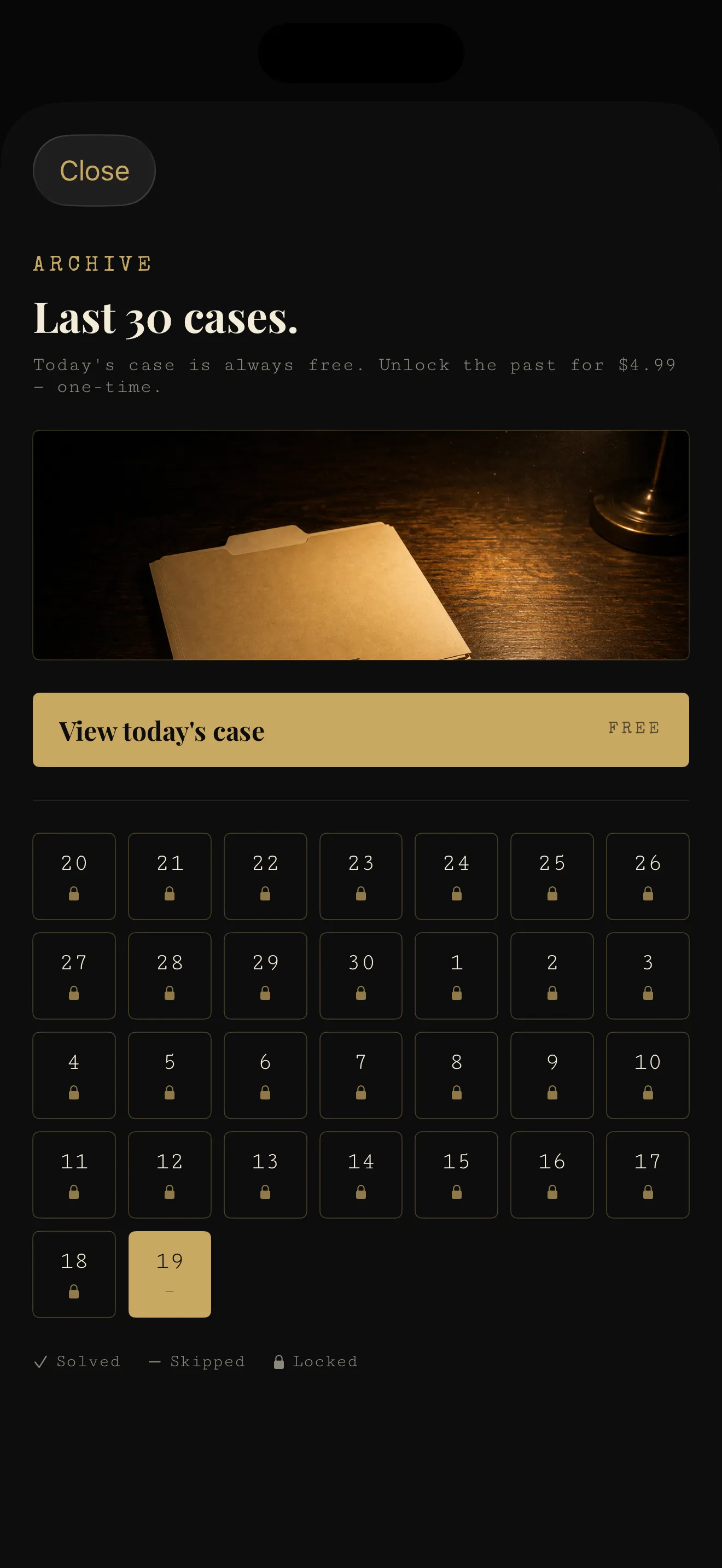
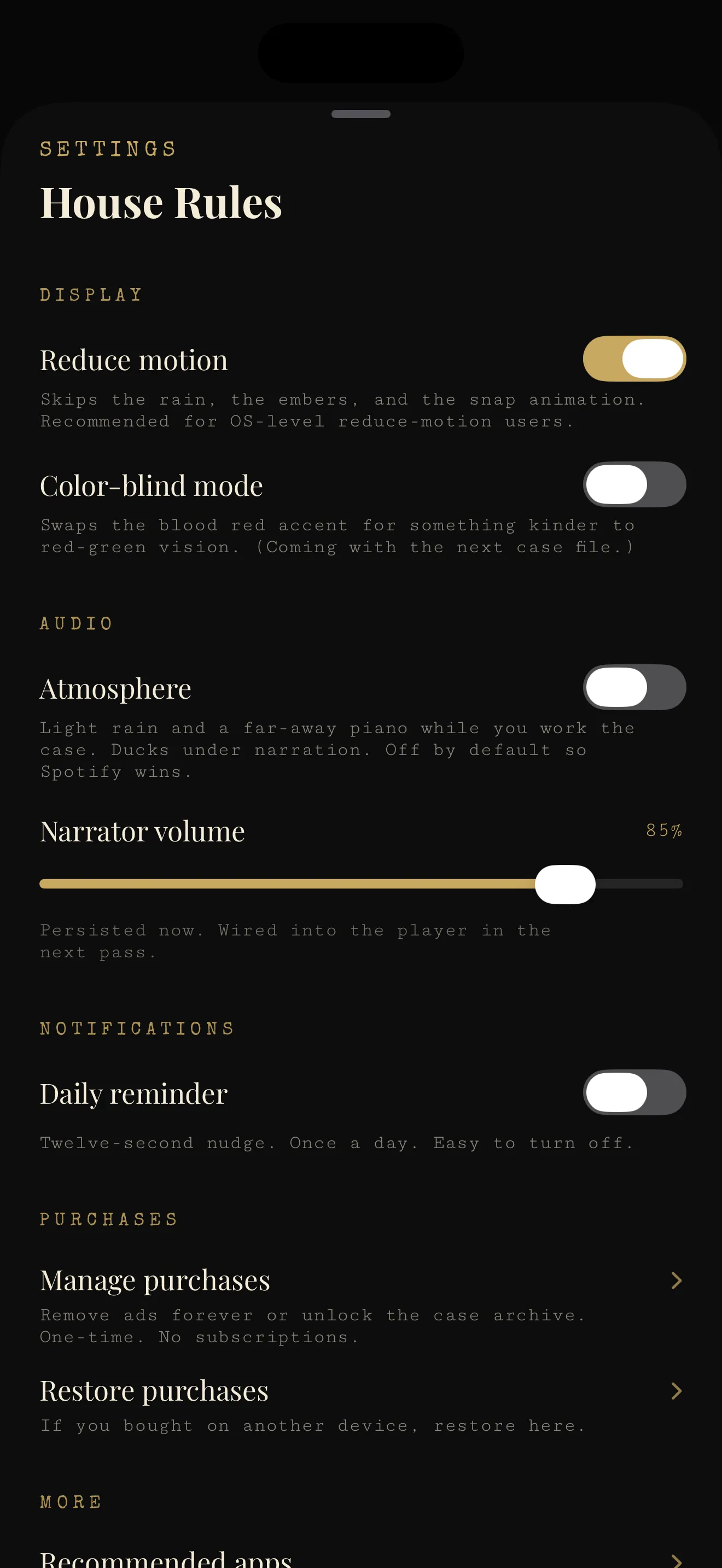
Casefile Daily is free. You get today's case every day, forever, with ads between cases. There is no subscription. There is no energy system. There are two one-time IAPs, each a flat fee: $2.99 to remove ads forever, and $4.99 to unlock the full archive of past cases. Both are optional. Both are genuinely optional—you will never lose the ability to play the daily case for free.
- Free: Today's case every day, forever
- $2.99 one-time: Remove ads (they run between cases, never during play)
- $4.99 one-time: Unlock the archive and replay any past case
The archive unlock is a meaningful unlock. If you missed a case, or you want to solve more than one per day, the archive opens 365+ cases—every case that has shipped since launch. This is the opposite of the subscription trap: you pay once, and the feature is permanently yours. The app will work fine without it. But if you find yourself reaching for past cases, or if you lost a streak and want to recover it, the archive is there.
The voice: pre-generated, not AI-on-demand
Every case is narrated by a hardboiled detective. The narration is not generated in real-time on your phone. It was created once, before the app shipped, using ElevenLabs—a professional voice-synthesis service—and then bundled into the app as a compressed MP3 file. When you open the case, you're playing back a pre-recorded clip, not calling an API. This matters because: one, it works offline; two, it's fast; three, it respects your privacy (nothing about your gameplay is sent anywhere); four, the audio is consistent and human-sounding (not the robotic quality of real-time synthesis).
With subtitles on by default, the narration works in loud environments (transit, coffee shops). With a separate volume control from music, you can dial in the detective's voice independent of any background audio. For players who use VoiceOver, the transcripts are available and screenreader-accessible. This is accessibility built into the core experience, not retrofitted.
Why daily? Why not infinite?
An infinite puzzle app—one you can play endlessly—creates a different ritual. You're competing with the app itself for your time. You're racing the clock. You're trying to solve faster than you did yesterday. Casefile Daily rejects this. One case per day. If you solve it in five minutes, you're done. There's no next level. There's no "just one more." There is tomorrow. This constraint—one case, one day, take your time—is the whole point. It's a ritual, not a compulsion. It's a moment in your morning, not an hour before bed. It's the difference between a daily newspaper and an infinite scroll.
One case per day. If you finish early, you're done. Tomorrow is coming.
This also preserves the detective's casework. Each case matters because there's only one. There's no filler. There's no procedural generation diluting the mystery. Every narration, every clue set, every grid is thoughtful. And because cases reset at the same moment for everyone globally, there's a shared moment—millions of people solving the same mystery, the same day, knowing that everyone else has the same case. It's the opposite of personalization. It's synchronous, public, and finite.
The experience: no ads during, no interruption
Casefile Daily runs ads between cases, not during. You listen to the narration. You fill the grid. You close the case. Then, if you haven't paid to remove ads, you see an ad. But that twelve seconds of detective voice and those five minutes of puzzle-solving are uninterrupted. The noir mood is not broken. Your streak is not punctuated by a banner ad or a pop-up. This is a deliberate choice: the app respects the experience you came for.
The app also works fully offline. Once the daily case is loaded, you don't need the internet to play. The narration is on your phone. The grid is in memory. The clues are local. You can solve on a plane, in a tunnel, in a subway. This is intentional design for the commuter use case: you have five minutes before your stop. You don't want to worry about connectivity.
This article was drafted with AI assistance and reviewed by a human editor before publishing.