How often should a horse see the farrier?
If your farrier just asked "same time in six weeks?", this page will help you decide whether to say yes, ask for five, or push for eight. The right interval is a range, and it moves with your horse's shoes, workload and the time of year. Every starting number below comes with its source, and the hoof-growth arithmetic shows why the published figures seem to disagree.
How often should a horse see the farrier, by type of horse?
Mad Barn's farrier care guidance puts most horses at 4 to 6 weeks, allows retired horses longer, and says performance horses with conformation problems may need a strict four-week cycle. petMD describes what many owners actually book: 6 to 8 weeks in summer, 6 to 12 in winter, and 4 to 5 for horses that grow long toes or keep losing shoes. Anything past 8 weeks is a winter or retirement schedule to agree with your farrier. It isn't a default.
The numbers look contradictory because each source is describing a different horse. New Mexico State University Extension gives 6 to 12 weeks for the average horse, adjusted for climate and the individual. The tightest figure comes from the one source that actually measured feet. A study of 26 riding-school horses measured hooves before and after farriery on a 4 to 6 week cycle and concluded that an interval of six weeks or less could prevent excess loading inside the hoof and reduce long-term injury risk. If your horse works most days, six weeks is the number to beat. Here are the starter intervals side by side, shortest cycle first.
- Performance horse with conformation problems
- A strict 4 weeks (Mad Barn)
- Long toes or shoes that come loose
- 4–5 weeks (petMD)
- Riding-school or hard-working horse
- No more than 6 weeks (26-horse study, PMC)
- Most horses, general guidance
- 4–6 weeks (Mad Barn)
- Healthy horse, light summer work
- 6–8 weeks, a common owner schedule (petMD)
- Healthy horse, winter
- 6–12 weeks as growth slows (petMD)
- Average horse, barefoot or shod
- 6–12 weeks, adjusted for climate and the horse (NMSU Extension)
- Retired horse
- Longer than 4–6 weeks; agree the number with your farrier (Mad Barn)
Use the table to open the conversation with your farrier, not to replace it. Your farrier sees what this particular horse's feet look like at the end of a cycle, and no table can. For more on matching the cycle to workload, shoes and terrain, read our guide to how often a horse really needs the farrier.
How fast do horse hooves grow?
Roughly a quarter to three-eighths of an inch a month. Extension.org gives that 1/4 to 3/8 inch range, about 6 to 9.5 mm, and points out that with a hoof wall 3 to 4 inches long, a horse grows a whole new hoof about once a year. NMSU Extension uses 3/8 inch as its average. A small Journal of Equine Veterinary Science study summarised by VIN Veterinary Partner measured a little faster, 8 to 10 mm a month. Age, season, injury and nutrition all move the figure.
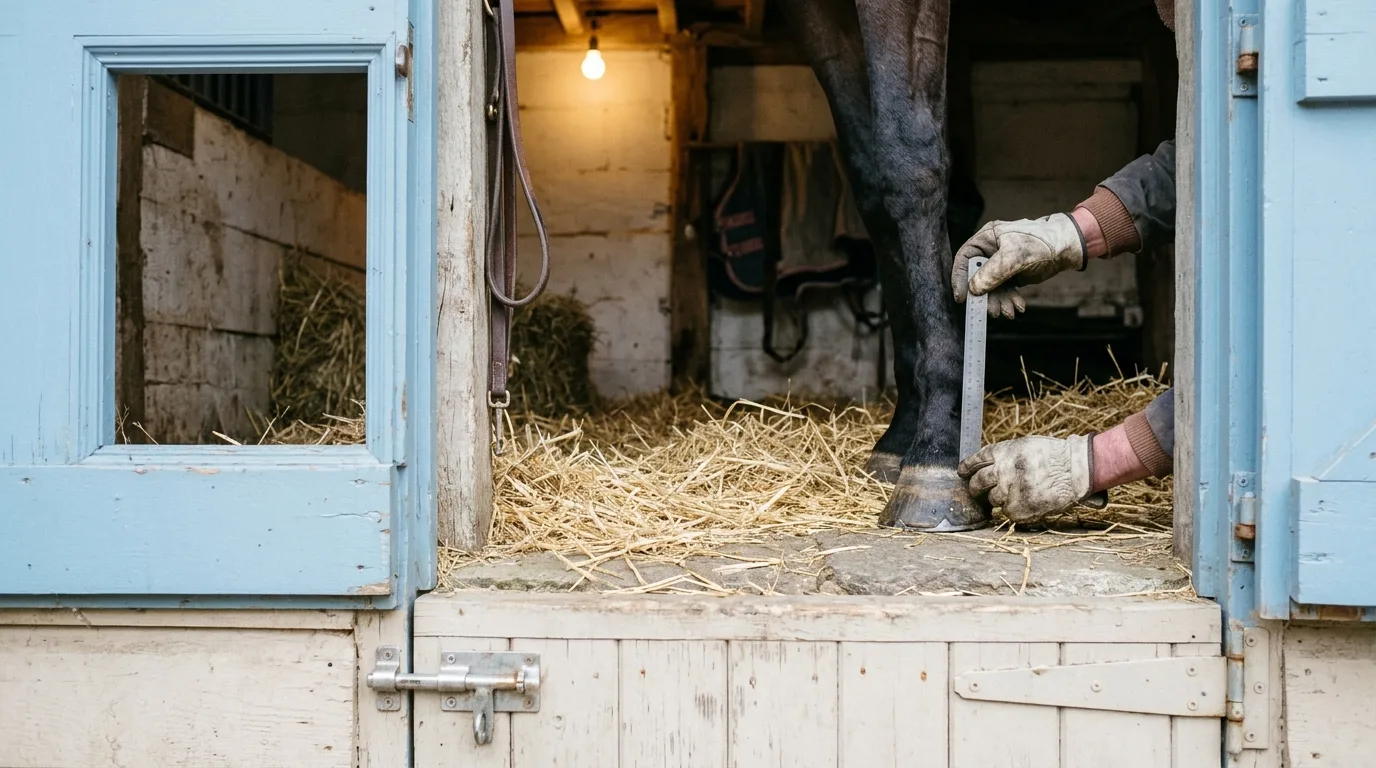
Run the study's 8 to 10 mm a month through the calendar and the farrier ranges start to make sense. These are approximate:
- Week 4: about 7 to 9 mm of new hoof
- Week 6: about 11 to 14 mm, close to half an inch
- Week 8: about 15 to 18 mm
- Week 12: about 22 to 28 mm, roughly an inch
That length doesn't arrive evenly. The toe moves forward, the point where the foot rolls over moves with it, and on a shod foot the heels can creep forward past the support of the shoe. The riding-school study measured this drift in balance between visits, which is why its authors landed on six weeks.
You can watch it happen. The day after a trim, stand your horse square on concrete and take a side-on photo of each front foot. Make it repeatable: chalk where the hoof stands and where you crouch, hold the lens level with the hoof, and frame the hoof and pastern the same way each time. Repeat at week 5. Side by side, the change in toe length and hoof angle is far easier to see than it ever is in a dim barn aisle.
Can you go longer between farrier visits in winter?
Often yes, for a healthy horse in light work, because hooves grow more slowly in the cold months. The study summarised by VIN Veterinary Partner found growth fell in winter and peaked in fall, and petMD reports many owners moving from 6 to 8 weeks in summer to 6 to 12 in winter.
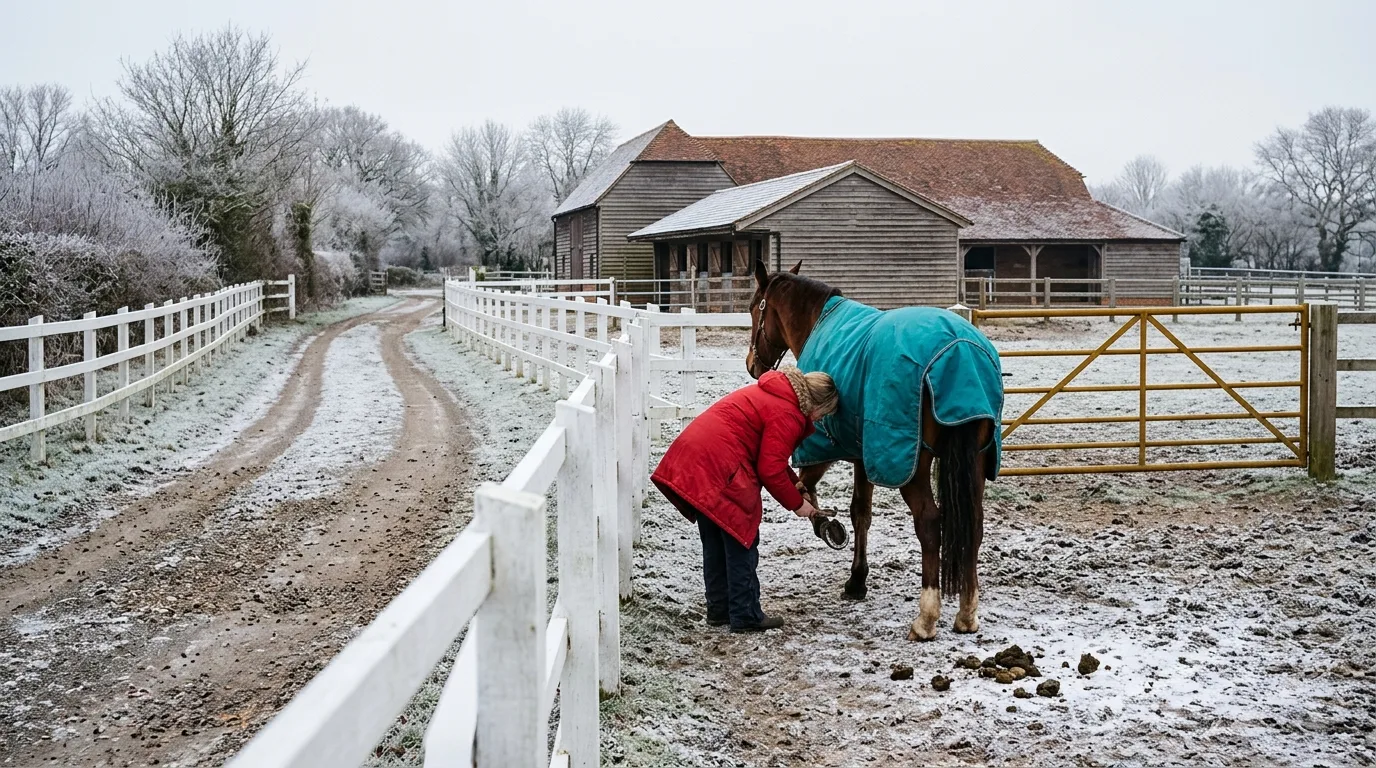
Most schedules miss the fall peak. If hooves grow fastest in autumn, the cycle that worked all summer can run long in September and October, just when you're tempted to stretch it. Hold or even tighten the cycle through fall. Lengthen it gradually as growth slows, then bring it back to your summer interval in spring.
Don't stretch a horse that's still working hard, one whose shoes already loosen by week five, or one with any history of hoof trouble. The saving is also smaller than it feels. The American Farriers Journal's 2026 benchmark puts the US average for trimming four feet at $61, from $54 in the central states to $75 in the far west. A year on an 8-week cycle instead of a 6-week one cuts roughly two visits: around $130 at the national average before trip fees, more or less depending on your region. One lost shoe and an extra call-out takes a good bite out of that.
How do you know your horse needs the farrier early?
When the feet change before the date does. Pick up and look at each foot when you groom, and check for these:
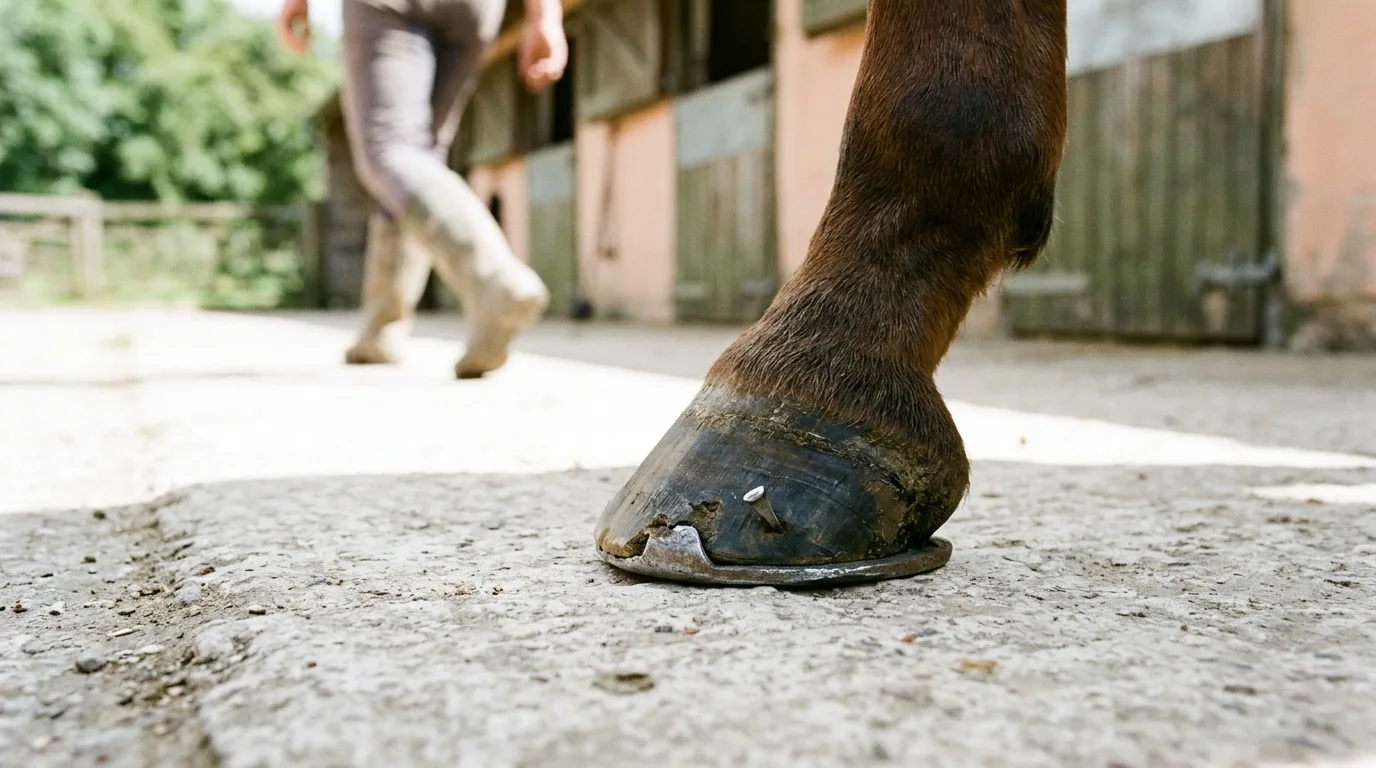
- Long toe: from the side, the front of the hoof no longer lines up with the pastern and looks like it's running forward.
- Flares: the wall bells outward, often on one side, instead of running straight down.
- Chips and cracks: pieces breaking off the edge of an unshod foot, or splits starting at the ground.
- Shoe trouble: a shoe that has twisted, clinks when the horse walks, or has nail ends (clinches) lifting away from the wall.
- Heels: on a shod foot, the heels look as if they're sliding forward over the end of the shoe.
- Movement: tripping or stumbling on ground your horse normally handles.
One sign once is a one-off. When you spot one, photograph it or note which week of the cycle you're in; the side-on photo routine above makes this easy. If the same sign turns up at roughly the same point in two cycles running, the cycle is too long. Tell your farrier and ask to shorten it. petMD notes that horses with long toes or a habit of losing shoes may need visits every 4 to 5 weeks. Lameness, heat in the foot or a pounding pulse at the back of the fetlock is a different matter: call your vet, not only the farrier.
How do you keep track of farrier, vet and deworming dates?
Keep every due date in one place that warns you before it arrives, because the farrier is only one of several clocks running at once. Adult horses should have a dental exam at least once a year and young horses every six months, according to AAEP guidance cited by Equus and University of Florida IFAS. Penn State Extension lists rabies, EEE/WEE, tetanus and West Nile virus as core vaccines, given once or twice a year to previously vaccinated adults. The AAEP's 2024 parasite control guidelines moved away from deworming every horse on a fixed calendar toward fecal egg counts once or twice a year. Our horse vaccination and deworming schedule sets all of these out in one place.
Juggling those dates is the problem we built Hoofprint to solve. You set reminders for the farrier, vet, vaccinations, deworming and dentist, and the app tells you before each one is due. When a visit is done you log it, adding a note, photos or the day's activity if you want to. Health records, from vaccinations to weight and medication, sit together with photo attachments and stats across all your horses. Your side-on hoof photos from the day after the trim and week 5 go into the log, so when your farrier asks how the last cycle went, you can show them instead of guessing.
Know what it won't do. Hoofprint doesn't choose your interval; you and your farrier decide it and you enter it. It doesn't book appointments or message your farrier. If you'd like everything entered in one sitting, the Hoofprint setup guide walks you through it.
Next time your farrier asks "same time in six weeks?", ask two things before you answer: what the feet looked like at the end of this cycle, and whether moving the date changes the trip fee. Then agree the interval your horse's feet support, set the reminder before the truck leaves the yard, and take the first pair of side-on photos the next morning.
Common questions
How often do horses need new shoes?
How often should a barefoot horse be trimmed?
How much does a farrier trim cost?
Is it bad to go 10 weeks between farrier visits?
How often should a horse with laminitis be trimmed?
How often does a horse need its teeth checked?
Sources
- Farrier Care for Horses: Hoof Balance, Trimming & Shoeing
- Why Do Horses Need Shoes? The Real Reasons, Pros and Cons, and When They're Needed
- Evaluation of Equine Hoof Care
- How a Horse's Hoof Grows
- Does a 4–6 Week Shoeing Interval Promote Optimal Foot Balance in the Working Equine?
- Seasons Affect Travel Patterns and Hoof Growth in Horses
- What Farriers Are Charging for Trimming & Shoeing
- Why Your Horse Might Need a Dental Exam Before Winter
- Equine Dental Care
- Vaccines for Your Horse
- Internal Parasite Control Guidelines
This article was drafted with AI assistance and reviewed by a human editor before publishing.