How to Win a 4-Digit Code Guessing Game (When There Is No Yellow)
Exact-spot-only code duels play nothing like Mastermind or Wordle. The opening guesses that actually earn information, why repeated digits are your sharpest tool, and the endgame where most players throw it away.
First, understand what you are not told
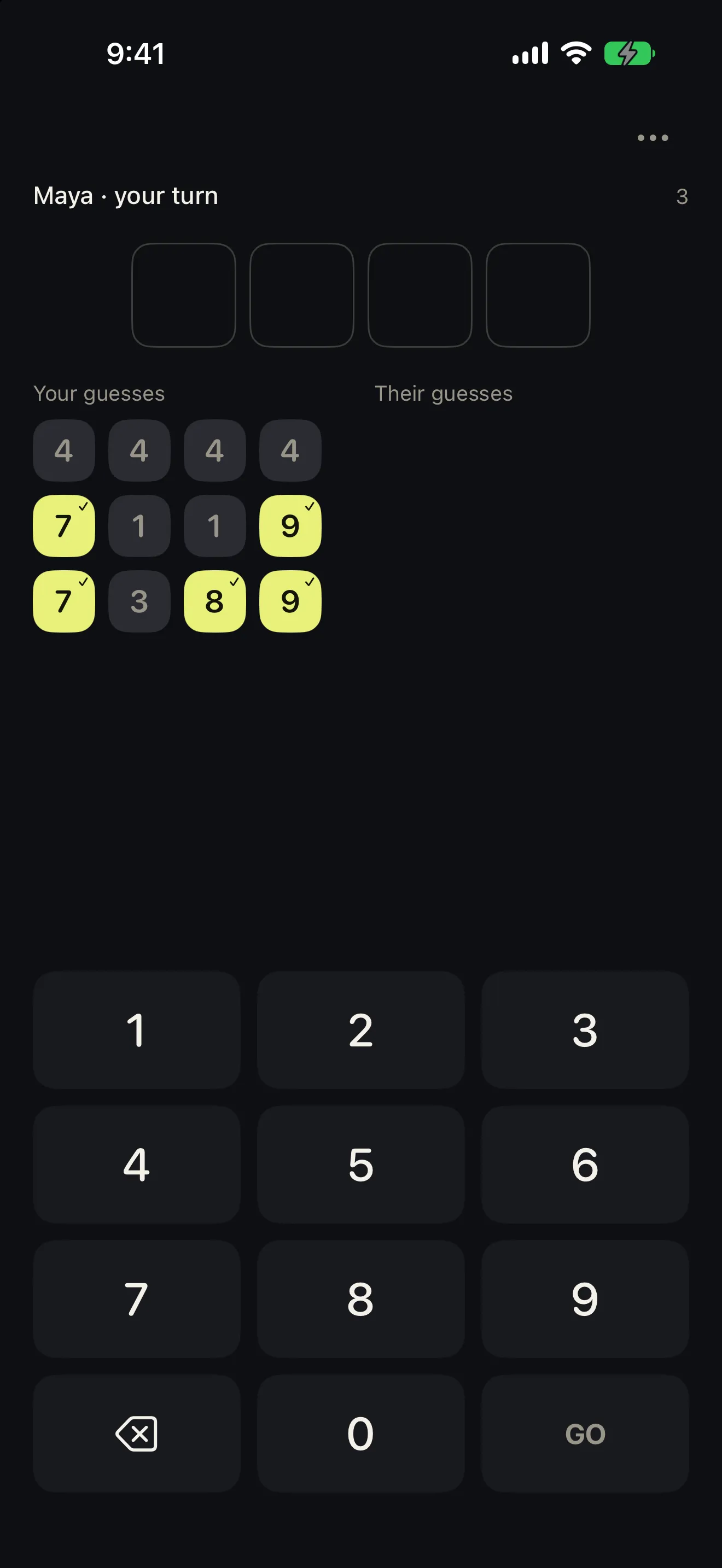
In Mastermind you get two kinds of feedback: right digit in the right place, and right digit in the wrong place. In an exact-spot-only duel like Don’t Peek, the second kind does not exist. A digit either locks in its position or it tells you nothing - not even whether it appears elsewhere in the code.
That single removed hint changes every piece of received strategy. Wordle openers and Mastermind information theory both lean on the "present but misplaced" signal, and without it, a miss is genuinely ambiguous: the digit might be absent from the code entirely, or sitting one slot to the left. Your plan has to make positions talk, not digits.
The repeated-digit opening
The strongest early guesses are the ones that ask one clean question. Guessing 4444 asks exactly: where does 4 appear? Every lock you get back is a solved position, permanently, with no ambiguity to untangle later.
A full sweep - 1111, 2222, and so on - would solve any code in at most ten guesses, but your opponent is solving too, and ten guesses is usually a lost race. The practical version is two or three repeat probes on likely digits, then a switch to composite guesses that recombine what you have learned. Codes set by humans are not uniform: birth years, door codes and keyboard patterns push 0, 1, 2 and 9 well above their fair share.
Make every guess pay double
Once a position locks, there is no reason to ever change it - keep the locked digit in place and spend the other slots on new questions. A guess like 7-1-1-9 against known locks at the ends is really a two-digit experiment wearing a four-digit coat.
The subtle habit that separates good players: track your misses as hard as your locks. A miss on 3 in position two does not rule 3 out of the code, but it does rule it out of that position - and positions are the only currency this game has. The shared history grid is your sticky note; read the whole column, not just the last row.
The three-of-four endgame
Three locks feels like winning. It is not - the last digit has up to ten candidates, minus only the ones your misses have eliminated in that exact position, and your opponent may be one guess from ending it. This is where players tilt: they start guessing the final slot at random instead of counting what they already know.
Slow down for five seconds. List which digits have already missed in that position across your whole history, cross them off, and spend your guess on the most likely survivor. In Blitz mode with ten seconds a guess, do the cross-off during your opponent’s turn instead - their guesses cost you nothing and their turn is your thinking time.
Playing the human, not just the code
Pass-and-play has a layer no solver has: you chose your own code, and so did they. Setting 0000 is legal and psychologically vicious, because almost nobody probes it early. Repeats in your own code blunt the repeated-digit opening - a 4344 gives a 4444 probe three locks, which sounds terrible until you realise it also tells your opponent nothing about the remaining slot.
And watch their reactions on the pass. The app hides the codes; it does not hide the wince. In Don’t Peek the history is public on purpose - the game assumes you were shouting your guesses across a table anyway - so the whole fight, bluffs included, happens face to face. See the Don’t Peek product page for how the one-phone version works, and its privacy policy for the short version of what the app knows: almost nothing.