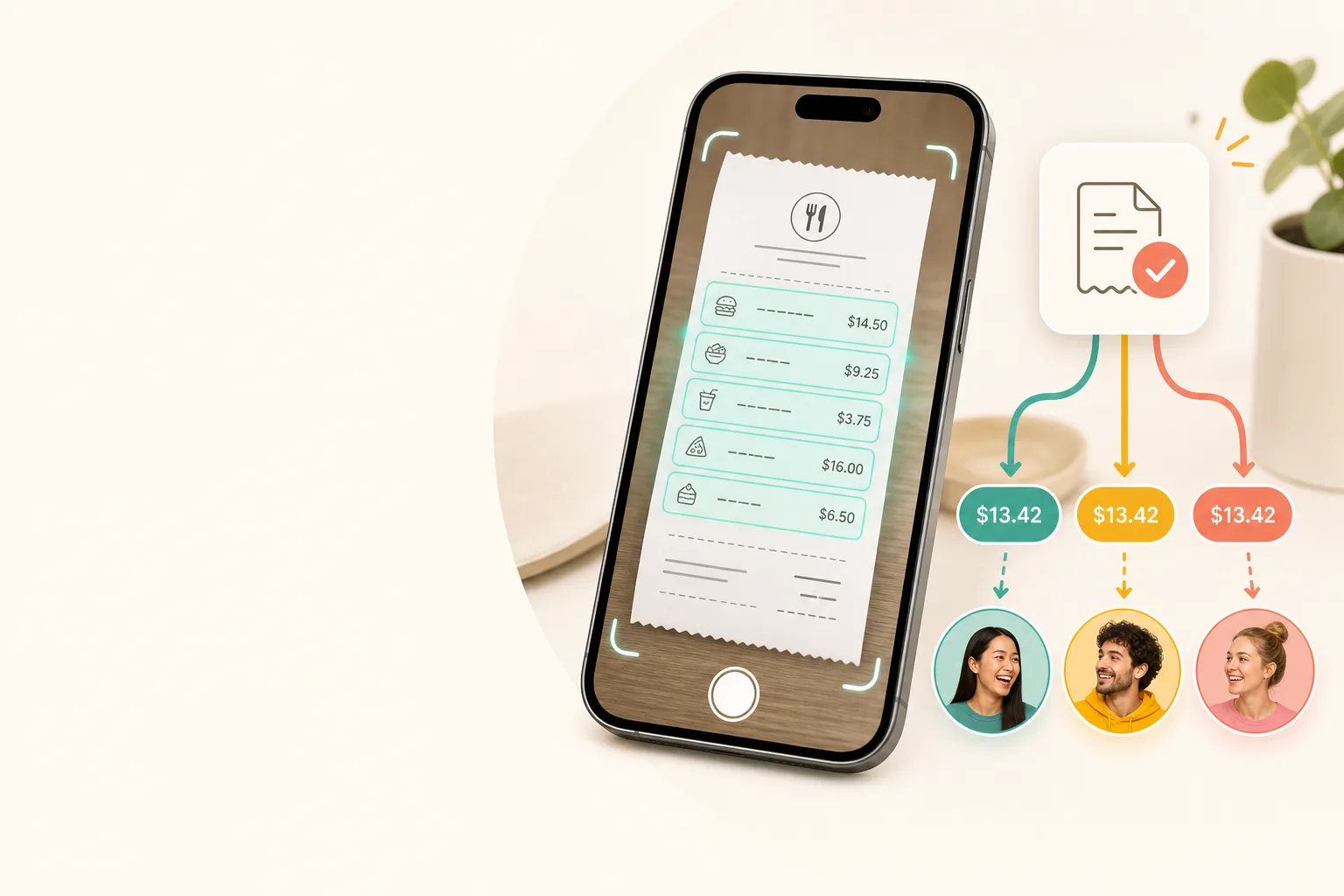
Splitting a bill used to mean one person typing every item into their phone while others watched and second-guessed the math. Today, AI changes that entirely. Instead of manual entry and mental arithmetic, you point your camera at the receipt and let machine vision handle the extraction. The differences between these two approaches aren't subtle—they affect how fast you settle up, how accurate your splits are, and whether dinner ends with relief or frustration.
The Old Way: Manual Entry and Mental Math
For years, bill splitting meant one of two things. Either someone manually typed every item, price, and modifier into a notes app or calculator—squinting at the receipt, pausing to confirm details, prone to typos—or you passed the receipt around and tried to remember who ordered the salmon versus the pasta. Both approaches are error-prone. Typing takes time. Memory is unreliable. Tax and tip calculations invite debate. By the time you've settled on who owes what, the moment of camaraderie at the table has usually passed.
The New Approach: AI Receipt Vision
AI receipt scanning flips the process. Instead of you reading and typing, the camera reads the receipt automatically. Modern vision models extract every line item, price, tax, and tip in one pass—typically in just a few seconds. This eliminates typing errors, removes manual math, and gives everyone a source of truth: the AI's reading of what was actually ordered and what it actually cost. The result feels simpler because it fundamentally is. No transcription phase. No calculator. No ambiguity about what the receipt says.
What Makes the Difference
Speed
Manual entry takes 2–5 minutes per receipt. AI scanning takes seconds. If you're splitting lunch weekly, that's hours saved per year.
Accuracy
Human transcription introduces typos, missed items, and decimal errors. AI vision reads the printed receipt as source material and extracts data with high consistency. You still get a review step to catch edge cases, but the baseline is higher.
Dispute Prevention
When the AI shows the exact receipt, disagreements about what was ordered or what it cost evaporate. The receipt is the arbiter, not anyone's memory.
Flexibility
AI scanning handles receipts in dozens of languages and currency formats—something manual entry can't do at scale. Travel and international meals become equally frictionless.
AI doesn't replace judgment—it removes friction so judgment can focus on what matters: splitting fairly, not transcribing receipts.
Where AI Receipt Scanning Fits
AI receipt scanning is most useful when receipts are complex (many items, multiple tax rates, significant tips), when accuracy matters (expense reports, group trips), or when speed matters (frequent dining out). It's less critical for a two-person coffee run where the math is simple. But for the weekly friend dinner, the team meal, the family vacation splitting costs across four currencies—AI scanning becomes your invisible accountant. Check out our guides on mastering AI receipt scanning and mastering bill splitting with AI to see both tools in practice.
The Hybrid Model: AI + Human Verification
The best implementations pair AI extraction with a human review step. The AI reads the receipt in seconds, then you (or anyone in the group) verify or adjust items before finalizing the split. This gives you AI's speed and accuracy while keeping control. You're not blindly trusting a machine; you're leveraging it to handle the tedious part—reading—and keeping humans in charge of judgment calls, like whether a shared appetizer should split evenly or weight toward whoever ate more.
- Time per receipt
- Manual: 2–5 min | AI: 5–30 sec
- Transcription errors
- Manual: Common | AI: Rare
- Multi-language support
- Manual: Limited | AI: 30+ languages
- Currency conversion
- Manual: Manual calc | AI: Automatic
- Dispute potential
- Manual: High | AI: Low
The shift toward AI receipt scanning represents a simple truth: computers are better at reading and extracting data than humans, especially at speed and scale. The real value isn't in the AI itself—it's in the time and friction it removes from a task most people find tedious. That's where modern bill splitting lives.
This article was drafted with AI assistance and reviewed by a human editor before publishing.