Most bill trackers assume you want to optimize. Spreadsheet minimalism. Data integration. Aggressive notifications. But for many people, opening a bill tracker feels like opening a banking app—and opening a banking app feels like a panic attack. Crashout Calendar starts from a different place: what if a bill tracker was designed to make you feel less scared? Not less financially aware, but less ashamed. Less trapped. Less alone with the dread of recurring charges you forgot about. That's the core of Crashout Calendar—a soft, private calendar that shows you your month at a glance, tells you how much breathing room you have until payday, and includes step-by-step guides to cancel the subscriptions you no longer want.
Design starts with kindness, not fear
The visual language of most financial apps is built around urgency and control. Red alerts. Stark numbers. A sense that one wrong move will spiral into debt. Crashout Calendar rejects that aesthetic entirely. Instead, you get a soft, calendar-based interface that mirrors how humans actually think about bills—not as abstract data points, but as events scattered across a month. The color palette is warm. The typography is readable. There are no alarm bells, no warnings, no sense of judgment when you open the app.
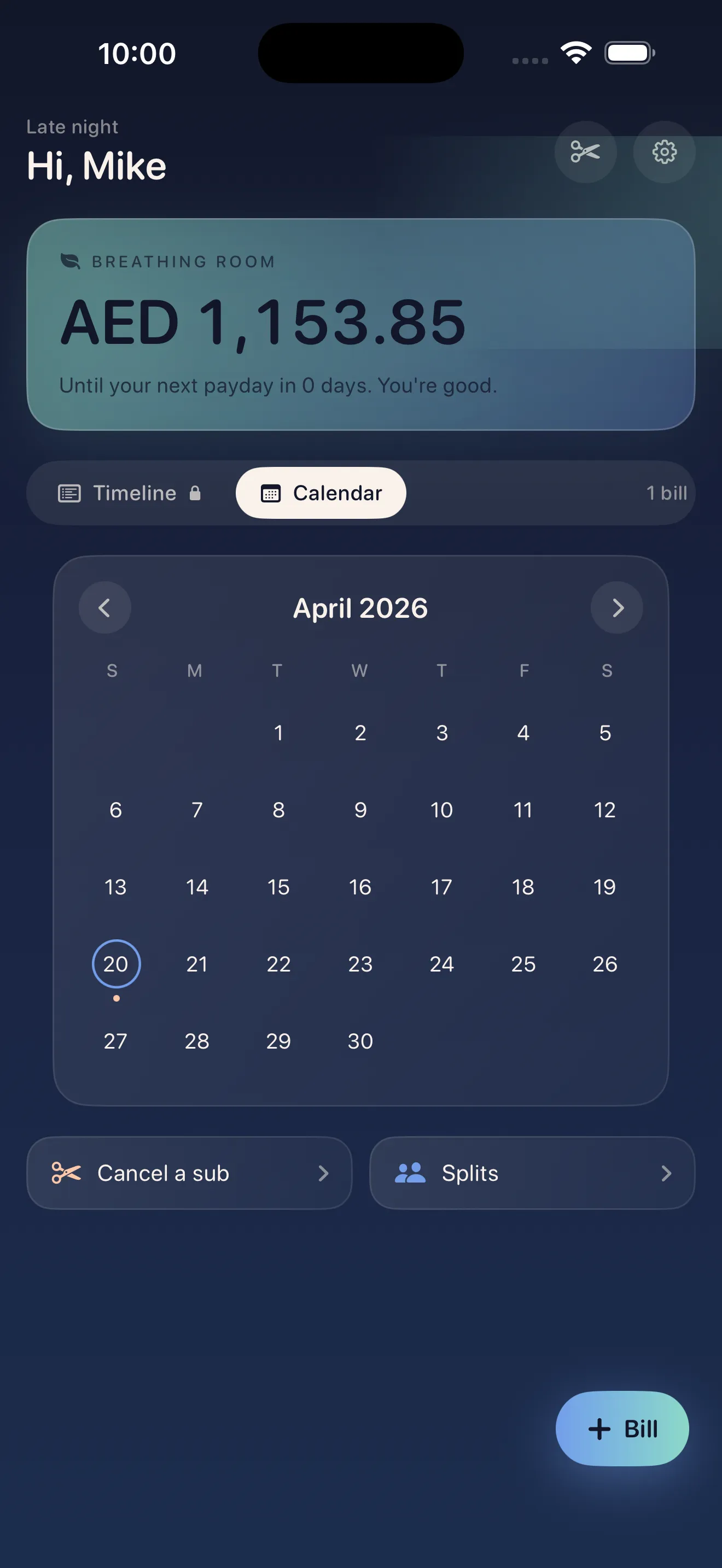
A bill tracker doesn't need to feel like a threat. It can be quiet, clear, and kind.
Breathing room as a core metric
One number changes how you feel about your finances: how many days until payday after all your bills are paid. Crashout Calendar calls this "breathing room," and it's the first thing you see. Not your total bills, not your account balance, not a spending forecast. Just: how long can you breathe? This reframing is subtle but profound. Instead of obsessing over total outflow, you focus on the margin between bills and income. That margin is what lets you sleep at night.
Setup takes three minutes, not thirty
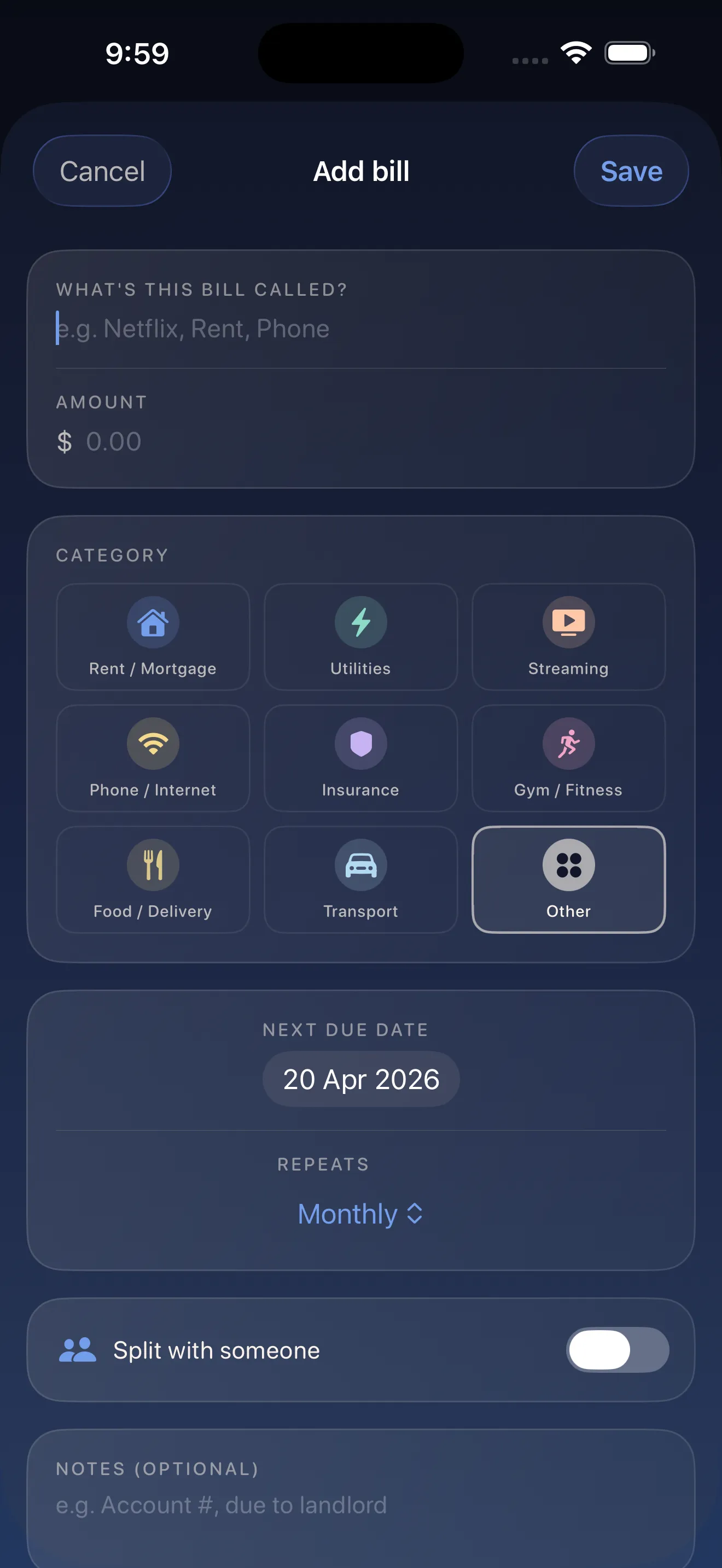
Friction kills habit formation. Crashout Calendar knew that if adding a bill took five minutes, you'd either abandon the app or abandon accuracy. So the design focuses on speed. You can add eight recurring bills in three minutes. Smart categorization guesses whether a charge is a subscription, a utility, or a rent payment. Recurrence detection handles the math—monthly, annual, bi-weekly—so you don't have to think. The form is ruthlessly short: name, amount, due date. That's it.
Cancel what you don't use without the shame spiral
"I forgot I was paying for that" is a universal experience. Crashout Calendar includes built-in cancel guides for 20+ services—Netflix, Spotify, Hulu, HBO, Disney+, and others. Each guide is step-by-step, no concierge fee, no redirect to a help desk. The idea is simple: if you can see a charge in Crashout Calendar, you should be able to cancel it without leaving the app. No shame, no guilt, no jumping through hoops. Just: here's what you're paying for, here's how to stop.
Privacy by design, not by promise
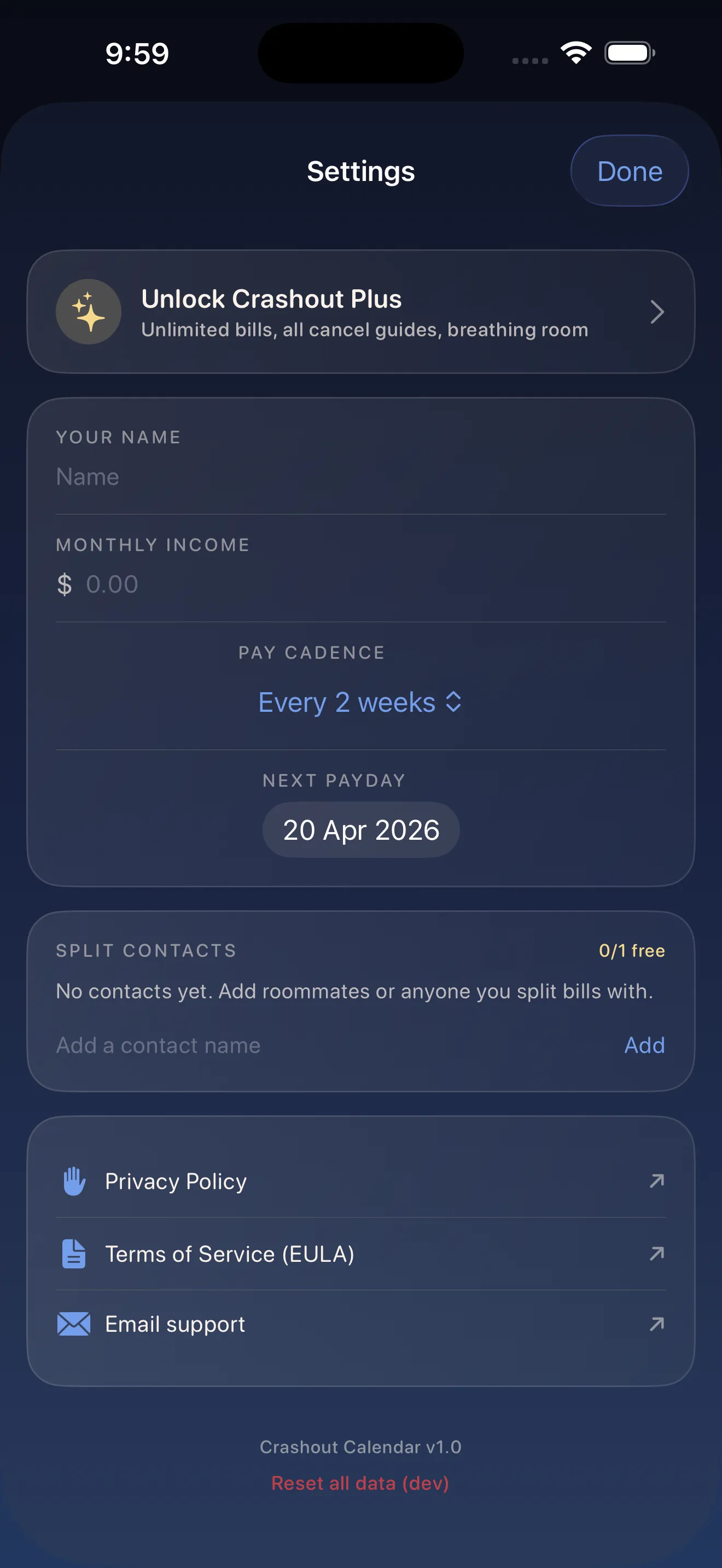
Crashout Calendar doesn't ask for your bank login. No Plaid integration. No syncing to the cloud. No credentials stored anywhere. Everything lives in local storage on your device—which means your bill data never leaves your phone, and Crashout never has to secure it, sell it, or lose it in a breach. This is a deliberate choice that affects almost every design decision. You manually add bills, yes, but that trade-off buys you complete privacy. And for people who've felt unsafe or exposed by financial apps before, that matters. If you want to learn more about the design philosophy behind this approach, read how Crashout Calendar makes bills feel less scary.
Splitting without the awkwardness
Roommate money drama is a specific kind of tension. You owe each other, neither of you wants to bring it up, the spreadsheet gets messy. Crashout Calendar includes split tools that let you divide a bill, track who owes whom, and settle up without friction. No messages. No pressure. Just clarity. For people living with others, this quietly solves a daily conflict. If you're setting up Crashout for the first time, the five-minute setup guide walks you through every step, including split configuration for shared bills.
A tracker that doesn't track you
The underlying insight is this: a bill tracker's job isn't to judge you or optimize you. It's to give you visibility and breathing room. Crashout Calendar does both without assuming you want to be maximized. You won't get a notification urging you to cut spending. You won't see a financial score. You won't be tempted to pay early or late based on some algorithm's recommendation. You'll just see: this is what you owe, this is when it's due, and this is how much time you have left before it matters. That simplicity is the whole point.
Financial wellness doesn't require surveillance. It requires clarity and breathing room.
This article was drafted with AI assistance and reviewed by a human editor before publishing.