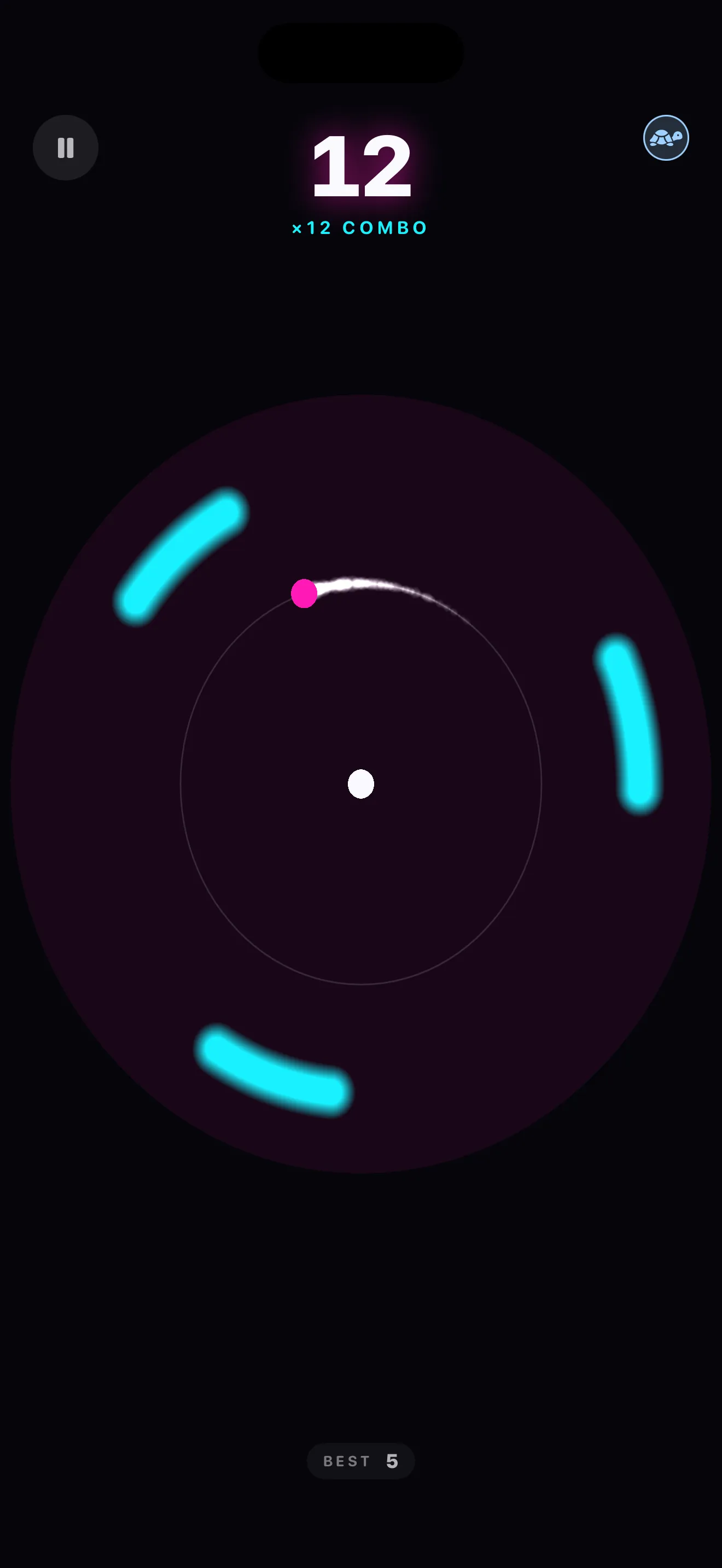
OrbTap looks simple: one dot orbits, targets rotate the other way, you tap the moment they align. That simplicity is the trap — most runs end because of a handful of fixable habits, not because reflexes gave out. This guide walks through the timing, positioning, and warm-up tricks that separate a five-hit run from a fifty-hit one.
What you'll have after this guide
In about ten minutes of reading and one short practice session, you'll have a repeatable pre-run routine, a clear read on when to grab each power-up, and a tap rhythm that holds up once the orbit speeds up — the difference between panicking at hit fifteen and coasting past it.
- A charged iPhone with OrbTap installed
- Five uninterrupted minutes for a baseline run
- Sound or haptics on, if that's how you normally play
- A willingness to lose on purpose a few times while testing timing
OrbTap belongs to a small category of one-tap arcade games built entirely around a single decision. If you want the wider context on why that constraint works so well on iPhone, the one-tap arcade game resource is worth a look before you dig into technique.
Start with a five-run baseline
Step 1: Play five runs without changing anything
Before adjusting your timing, find out where you actually fail. Play five runs in a row, note your score each time, and resist the urge to tweak your tap style mid-way. Most players discover their misses cluster around the same target color or the same speed threshold — that's the thing to fix first, not a vague sense of 'I need to be faster.' If you're still settling into the controls, the beginner's guide covers the basics before you start optimizing.
Watch the gap, not the dot
Step 2: Track the shrinking gap between the two rings
Your eyes want to follow the orbiting dot, but the useful information is the gap between it and the target. Shift your focus to that shrinking space and you'll start tapping on the gap closing rather than reacting to the dot's arrival — which is a half-beat faster. This is the single biggest form change that turns near-misses into hits.
Tap on the beat, not the panic
Step 3: Set a mental metronome before the run speeds up
OrbTap accelerates after every hit, and panic tapping is what ends most runs. Instead of reacting to each alignment individually, find the rhythm of the current speed and tap on that beat. When the game speeds up, give yourself one full rotation to reset the beat before trying to match it exactly.
Position for power-ups before you need them

Step 4: Steer your orbit path toward power-ups early
Slow-Mo, Double-Score, and Shield aren't earned by tapping — they're collected by where your dot sits on the orbit path. Start drifting toward one the moment it appears instead of waiting until you're already close to a miss. A Shield picked up at score six is a free life; a Shield you never reach is nothing.
Bank Slow-Mo and Shield for the danger zone
Step 5: Save your power-up timing for the speed jump, not the easy stretch
It's tempting to trigger Slow-Mo the second you grab it, but the biggest return comes from using it right as the orbit speed jumps, when your reaction time is tightest. Shield works passively — it absorbs your next miss automatically — so grab it and forget it. Double-Score is the exception: use it immediately, since ten seconds of doubled hits is worth more early than late.
Build a two-minute warm-up ritual

Step 6: Run one throwaway game before your serious attempt
Your first run of a session is rarely your best — your eyes haven't adjusted to the orbit speed yet. Play one deliberately low-pressure run, let it end however it ends, and treat your second run as the real attempt. This two-minute habit alone tends to add several hits to a personal best.
Chase your own ceiling, then the leaderboard

Step 7: Beat yesterday's score before you check GameCenter
It's easy to open the GameCenter leaderboard and immediately feel behind. Instead, keep a private target — your own best — and only check the leaderboard once you've beaten it. The walkthrough guide has a good breakdown of how leaderboard tiers are actually spaced if you want the full context.
Common questions
Should I grab every power-up I see?
Not always. Double-Score is worth detouring for almost any time since it multiplies your score for ten seconds, but chasing a distant Shield when you're already stable can cost you the hit you were lined up for. Prioritize whichever power-up sits closest to your current orbit path.
Why do I keep missing right after the orbit speeds up?
The speed jump changes your rhythm before your eyes adjust to it. Give yourself one full rotation after a speed increase to reset your mental beat instead of trying to match the new pace on the very next alignment.
Is Shield worth collecting if I'm already playing carefully?
Yes — Shield absorbs exactly one miss and does nothing else, so there's no downside to holding it. It's most valuable as a buffer against the one true panic-tap everyone eventually makes.
What's the fastest way to build good habits without playing dozens of runs?
Keep a short pre-run checklist — eyes on the gap, one warm-up run, no power-up chasing without a plan. Our checklist collection has more formats like this if a written routine helps you more than practice alone.
This article was drafted with AI assistance and reviewed by a human editor before publishing.