How to Document a Noisy Neighbour with Your iPhone
A practical guide to recording noise evidence that landlords take seriously: how to measure consistently, what dBA numbers mean, what an iPhone can and cannot prove, and how to turn a fortnight of sessions into one PDF report.
Why "it is too loud" never works on its own
Most noise complaints fail for the same reason: they are a feeling, delivered in the moment, with nothing behind them. A landlord or building manager hears one tenant's word against another's and has no basis to act. The complaint that works looks different — it is specific, repeated, and dated, and it shows a pattern rather than a bad night.
You do not need a certified instrument to build that. You need consistency: the same spot, the same method, and a timestamp you did not write yourself.
Measure the same way every time
Pick one position and keep it. Set the phone on a soft surface rather than a hard resonant one, remove any case covering the microphone, and keep it away from vents and open windows — moving air reads as noise. Do not hold it near your body, which reflects sound, and do not talk during a recording.
Use dBA. It is weighted to match how human hearing responds, and it is what noise regulations and health guidance almost always use. If the problem is bass through a ceiling or wall, dBC captures the low frequencies that dBA deliberately de-emphasises, which is often what makes a complaint legible to someone who has not heard it.
Record for a meaningful stretch rather than a few seconds. Leq — the equivalent continuous level — is the single most useful number for describing how loud something was overall across a period, and it needs enough samples to mean anything.
Know what the numbers actually mean
Rough context helps: a quiet bedroom at night sits near 30 dBA, normal conversation around 60, a vacuum cleaner near 70, and busy road traffic around 80. These are illustrative, not standards — your local noise ordinance is what governs the levels and hours that apply to you, and it is worth reading before you write to anyone.
Be honest about the limits, because the person reading your report may check. An iPhone microphone clips above roughly 100 dB and will read lower than reality, sometimes dramatically. Below about 30 dB the microphone's own noise floor takes over. The reliable band is roughly 40–95 dBA, which happens to cover almost every residential noise dispute.
Turn sessions into one document
Record on the nights it happens, over two weeks or so, adding a short location note to each session — "Living room, below Unit 4B" — so the readings are anchored to a place. Then export once, at the end, rather than sending a message every night.
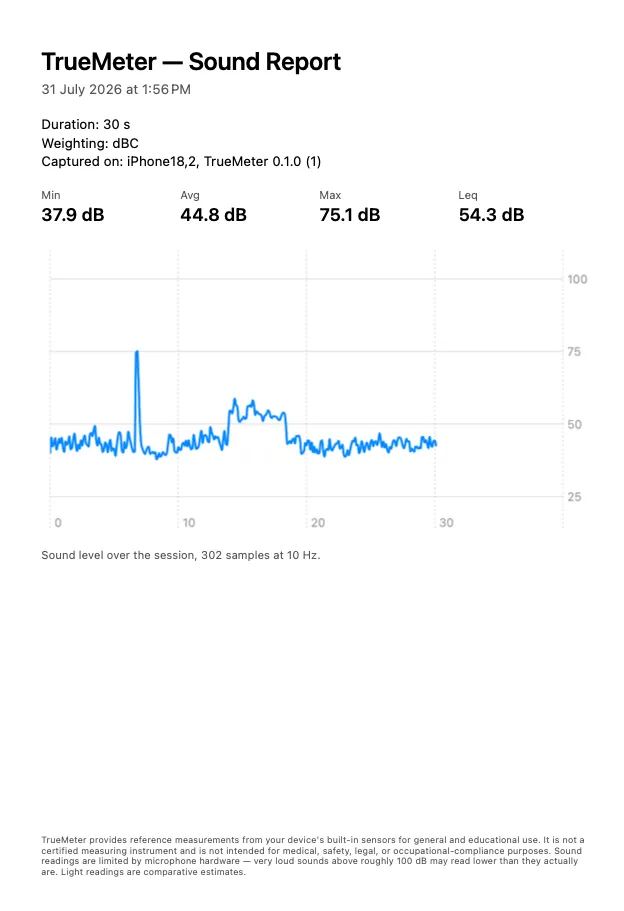
A TrueMeter PDF report contains the date, start time, and duration of each session, the location note, min, average, max and Leq, the full graph, your device model and app version, and the accuracy disclaimer. It is a consistent, timestamped record of what your phone measured. It is not a certified measurement and carries no legal weight on its own — say "documentation", never "proof" — but a fortnight of dated sessions in one clean document is frequently what moves a building manager from sympathy to action.
Where TrueMeter fits
TrueMeter is built around exactly this workflow: open, record, stop, repeat, export. Sessions save with automatic timestamps and full time-series data, History keeps them together, and Pro adds the PDF report, CSV export, dBC and dBZ weightings, and threshold alerts for a single $4.99 purchase with no subscription.
It also states its limits in the app rather than hiding them, which is the part that matters when you are handing the output to someone else. See the TrueMeter product page for screenshots, pricing, and the full privacy policy.