How to Stop Saying “Um”: A Practice Loop That Actually Lowers the Count
Fillers are your brain buying time, and trying not to say them rarely works. Record, count, listen, retake: a short practice loop that replaces the um with a pause, and how to run it in the two weeks before a talk.
Why you say um in the first place
A filler word is almost never a vocabulary problem. It is a timing problem: your mouth has reached the end of what you planned and your brain has not finished planning the next part, so it fills the gap with a sound that holds your turn. “Um”, “uh”, “so”, “like” and “you know” all do the same job — they tell the listener you are not finished yet.
That is why fillers bunch up in predictable places: at the start of an answer, at the turn between two ideas, and right before a pause. Once you see that pattern in your own speech, the fix becomes obvious. The pause was going to happen anyway. The filler is just noise laid over the top of it.
Why “just don’t say it” does not work
Most people know they use fillers and have tried to stop by willpower. It rarely lasts, for two reasons. First, you cannot hear your own fillers while you are speaking — your attention is on what you are saying, not on the sounds between words. Second, trying to monitor yourself mid-sentence adds a second task to an already busy brain, which produces more hesitation, not less.
What works instead is separating the speaking from the checking. Talk naturally, then look at what happened afterwards. That way the practice is about noticing the pattern, not about policing yourself in real time.
The loop: record, count, listen, retake
Record yourself for 30 seconds to two minutes on something real — the answer you will give, the opening of the speech, the first slide of the talk. Count the fillers. Then, and this is the step that matters, listen to two or three of them in context. Hearing yourself say “um” right before a pause does more than any number, because it shows you exactly where the gap is.
Then say the same thing again straight away. Not tomorrow — now, while you still remember where the fillers were. Aim to let the pause sit there empty instead of filling it. Compare the count with the take before. Two or three rounds of this in one sitting is usually enough to see the number drop, and the drop is what makes the habit stick.
Make the pause your friend
The goal is not zero fillers. It is replacing most of them with a short silence. A pause of half a second to a second feels long to the speaker and sounds deliberate to the listener; the same gap filled with “um” sounds unsure. Audiences tend to read pauses as confidence.
If silence feels uncomfortable, practise it on purpose: in your next take, pause for a full breath at every point where you would normally reach for a filler. It will feel slow. Played back, it almost never sounds slow.
Two weeks before the event
A few short sessions spread over the days before an interview, toast or presentation beat one long session the night before. Practise the parts you are least sure of — the opening, the transitions, the answer to the question you dread — because that is where the fillers live. Keep each session short enough that you would happily do another tomorrow.
Expect the count to bounce around. Nerves, tiredness and new material all push it up. What you are watching for is the second take being better than the first, not a perfect score.
Running the loop with Unfiller
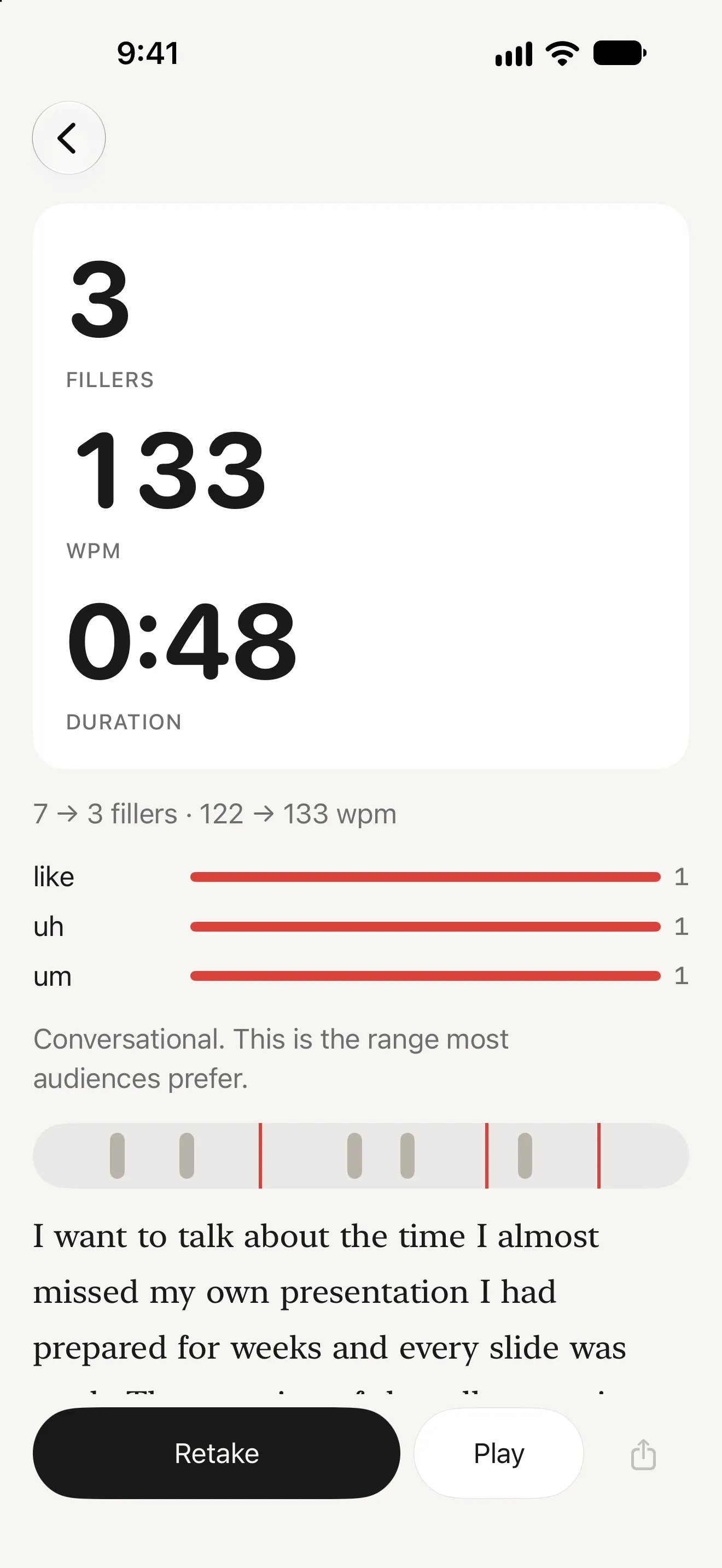
Unfiller was built for exactly this loop. Record a take and the moment you stop you get the filler count, your pace and the length, with a breakdown of which fillers you used, a pause map that shows them clustering before your pauses, and your transcript with every filler highlighted. Tap one to hear the three seconds around it. Tap Retake and the next result shows a delta against the last one — 7 → 3 fillers.
Everything is recorded and analysed on your iPhone, with no account and no audio uploaded. Your first three analyses are free and complete; Pro is $12.99 once for recordings up to ten minutes, every practice mode, your own filler list and transcript export.