
Most people who miss a bill will tell you the same thing: they forgot. But zoom out to the aggregate numbers and forgetting starts to look like the smaller part of the story. Households are carrying more recurring debt than a year ago, credit-card APRs are historically high, and the rules around what counts as "on time" are stricter and more literal than most people realize. BillWise: Bill Payment Tracker was built around a different premise than most reminder apps: that paying on time is less about memory and more about timing, cutoffs, and cash flow you can actually see coming.
The real problem isn't forgetting
Experian's September 2025 data puts average monthly consumer debt obligations at $1,256, up 2.6% from $1,224 a year earlier, with the average credit-card balance at $6,768 and the average variable APR at 22.83%. Experian's 2025 Consumer Credit Review also shows delinquency creeping up: the share of accounts at least 30 days past due rose from 2.01% to 2.21% year over year, and 60-day delinquencies climbed from 1.28% to 1.47%. Those aren't people who don't know what they owe. They're people juggling more revolving credit, more installments, and more recurring charges than a single mental list can reliably hold.
That's the gap BillWise is built to close: not a nagging list of dates, but a system that treats every bill, credit card, and installment as its own kind of obligation with its own timing rules.
Why "due date" doesn't mean what you think
The word "due" implies you have until midnight. In practice, card issuers work off a much narrower window. Under CFPB guidance, an issuer generally can't treat a payment as late if it's received by 5 p.m. on the due date, in the time zone named on your statement — but if that due date falls on a Sunday or a holiday, the rule shifts to the next business day. Crucially, the CFPB is explicit that payments must be received, not simply sent or scheduled; even online bill-pay can take time to process before it counts. Separately, CFPB guidance on late fees notes that paying at least the minimum by that 5 p.m. window protects you from a late fee — but paying less than the minimum may not, even if the payment arrives on time.
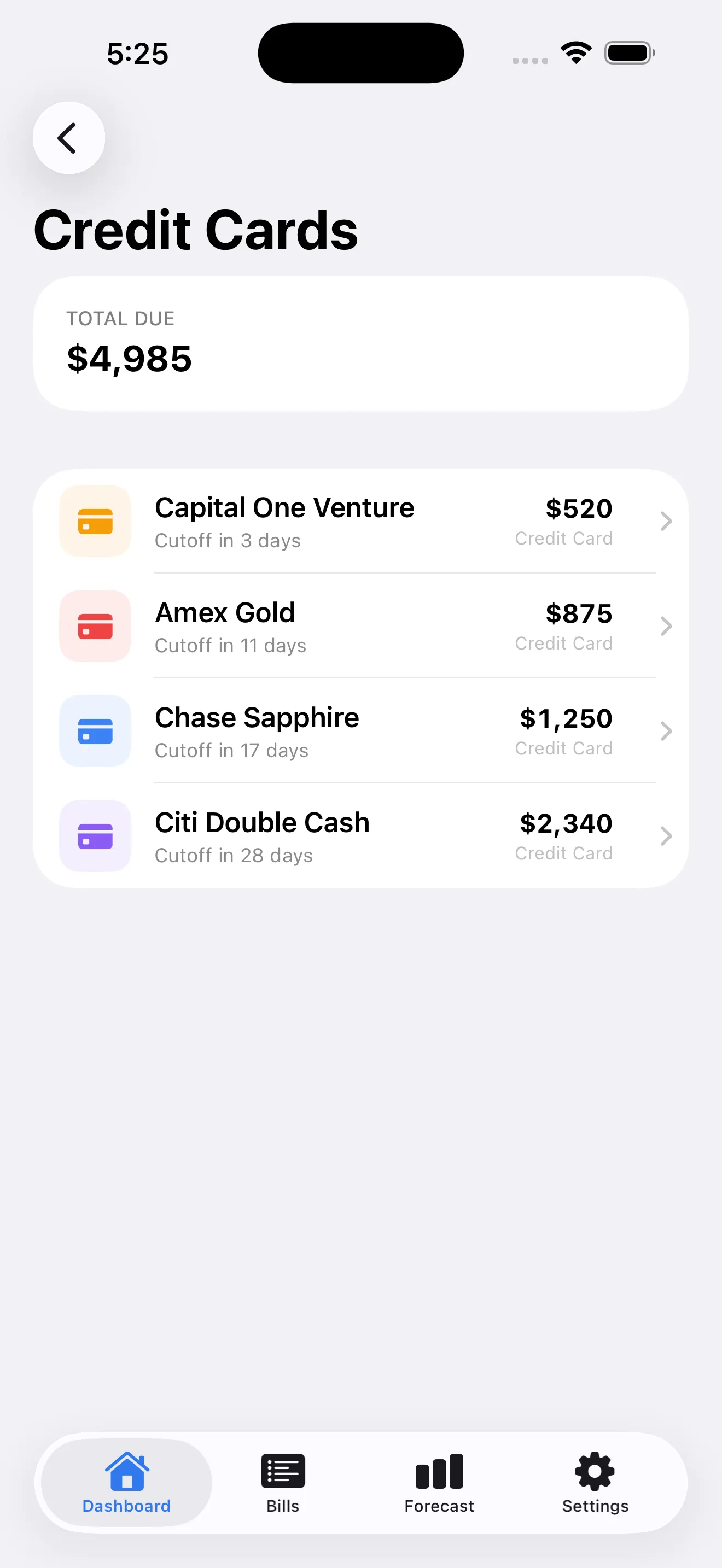
That's a lot of qualification packed into one date on a statement. It's also exactly why BillWise treats credit cards differently from every other bill type. The Cutoff-Aware Credit Cards feature separates a card's billing cutoff from its actual payment due date, so you're not just seeing "due the 15th" — you're seeing the cycle that produced that bill and how much runway you actually have before it's received, not just sent.
A due date isn't a deadline you meet by intending to pay. It's a deadline the issuer has to receive your money by, in their time zone, before their cutoff.
One place for every kind of obligation
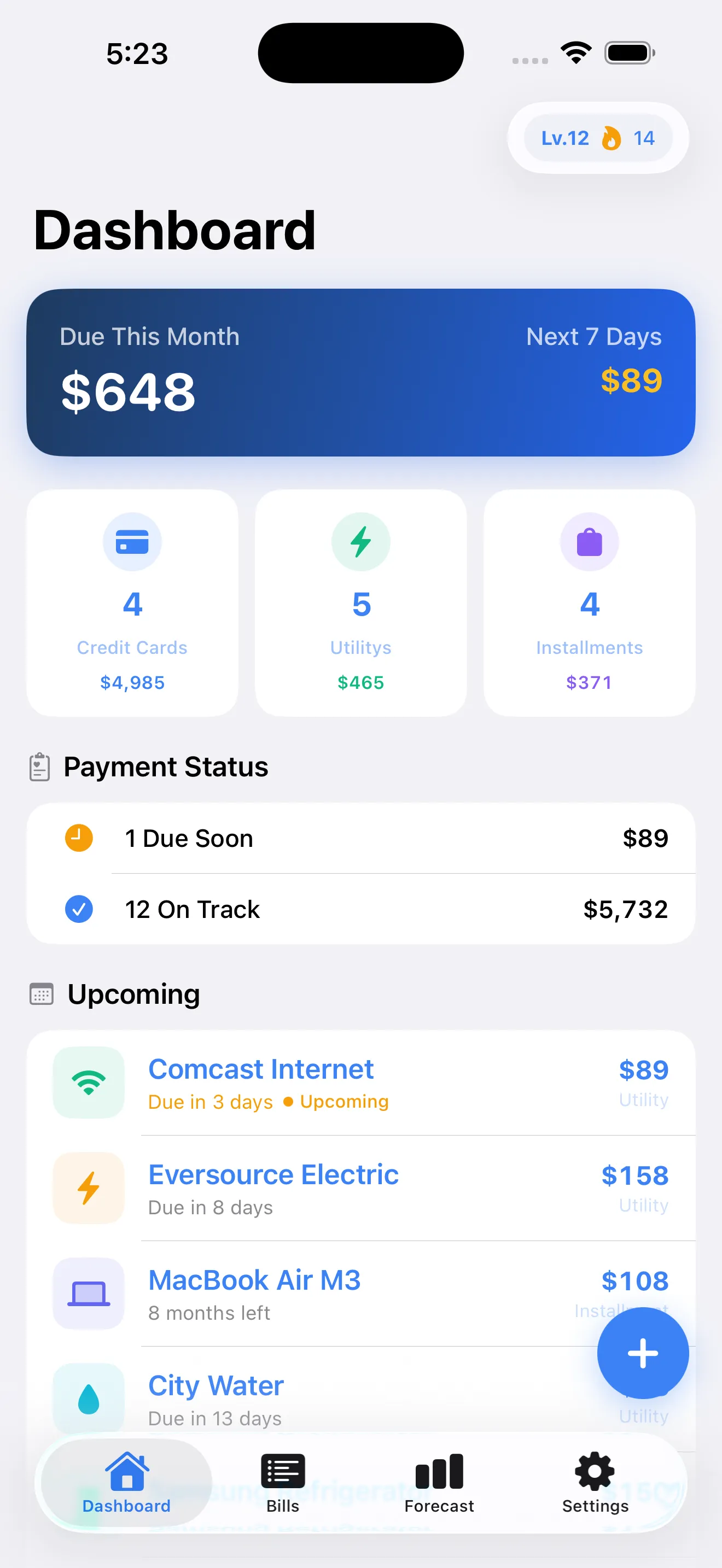
Credit cards, utilities, and installments don't behave the same way, so BillWise doesn't force them into one generic template. A utility bill runs on a billing cycle that can shift month to month. An installment has a fixed number of payments and a visible finish line. A credit card has a statement cutoff, a grace period, and a minimum-versus-full-balance decision baked in. The All Bills in One Place feature keeps the distinct logic of each type intact instead of flattening everything into a single generic "reminder," which is where a lot of the real information — and the real risk — tends to get lost.
Seeing around the corner
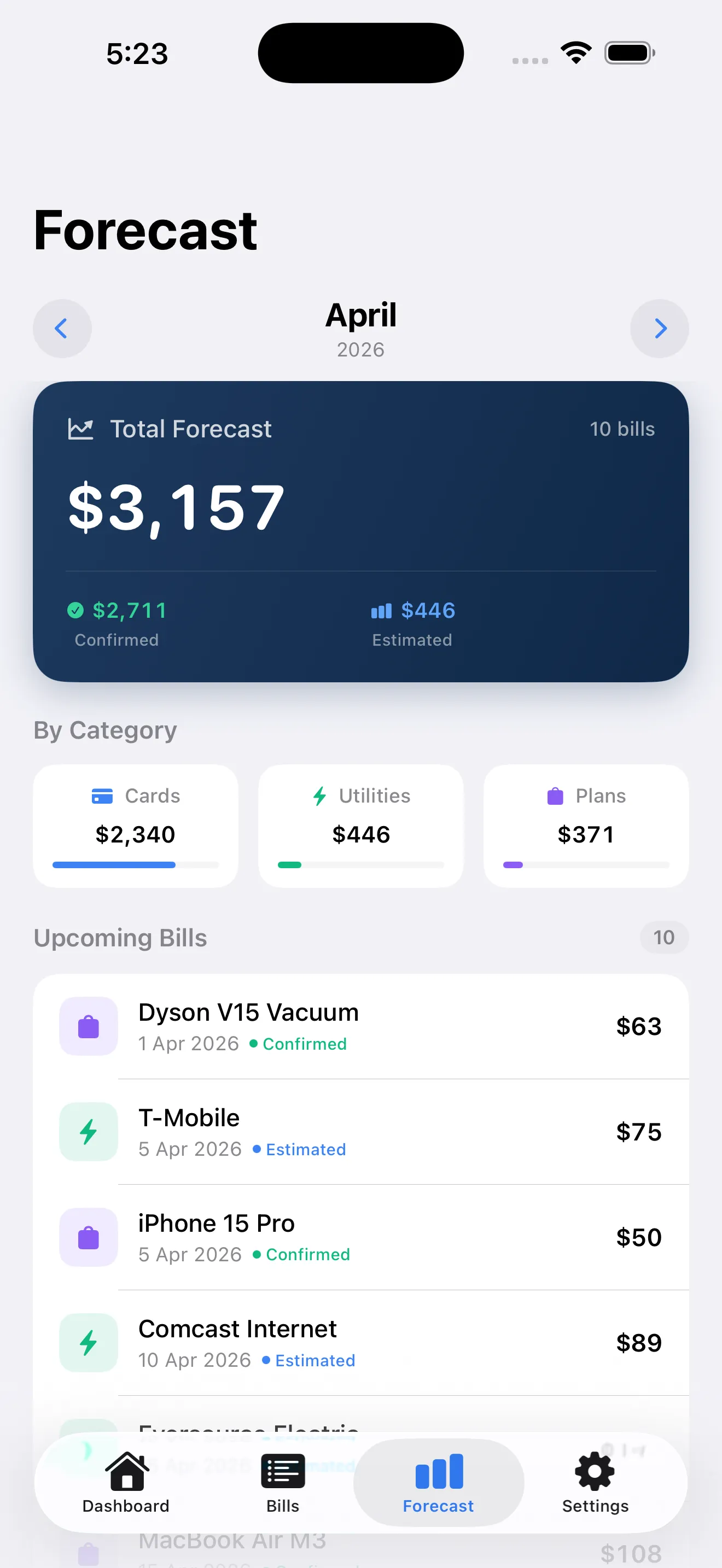
Knowing what's due today solves today's problem. It doesn't tell you whether next month is going to be tight. That's the gap Payment Forecasting is meant to fill — projecting your total upcoming obligations across bills, cards, and installments so a heavy month shows up on your radar before it shows up on your statement. Paired with a Smart Dashboard that surfaces what's due soonest, the goal is less "don't forget" and more "don't get surprised."
Turning discipline into a game worth playing
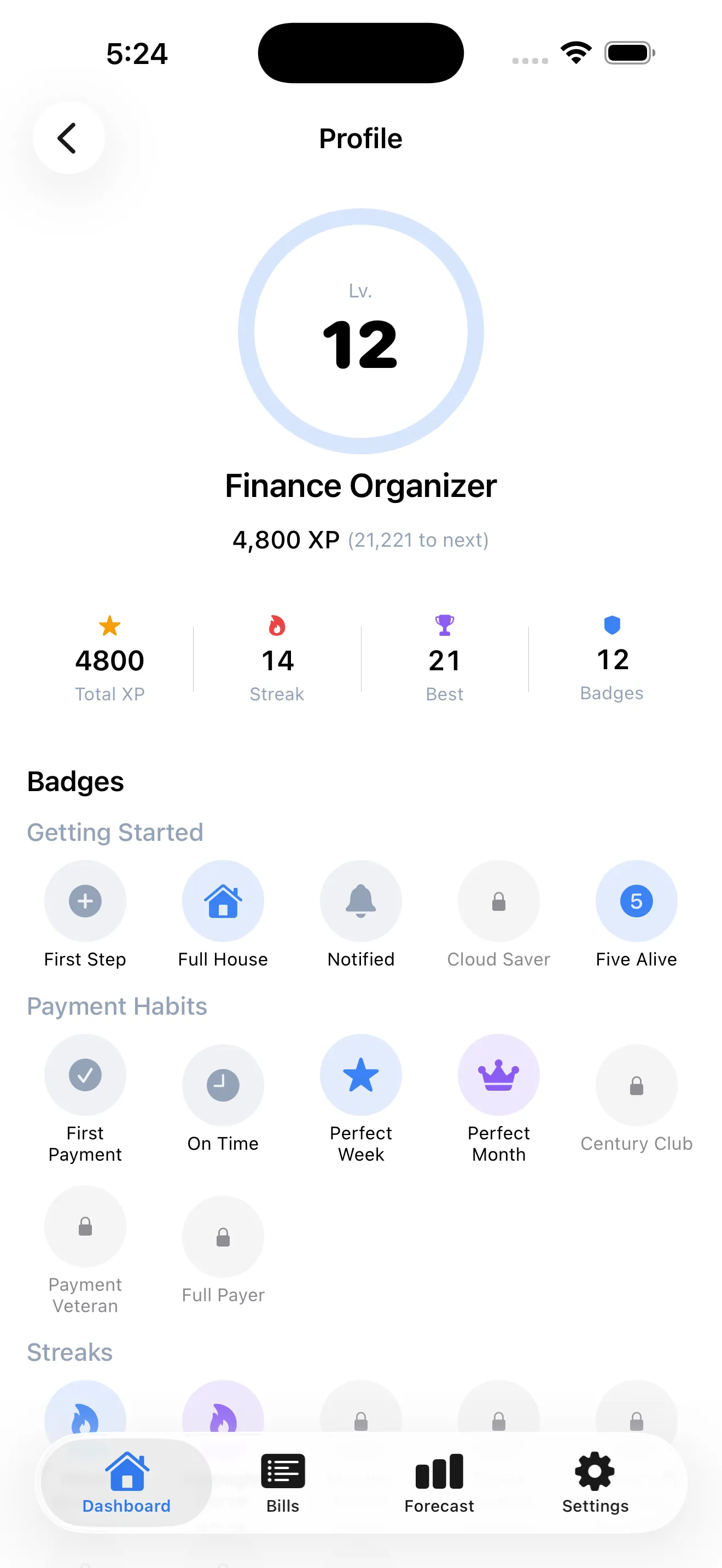
None of this matters if it doesn't stick, which is why BillWise leans into gamification instead of treating it as decoration. Paying on time earns XP; consistency builds streaks; streaks and levels turn into badges. It's a small mechanic, but it reframes the task: instead of dodging a penalty, you're building a record. For anyone getting started, the first-time setup guide walks through logging your first bill and starting that streak on day one.
Where on-time payment is headed
The platform underneath bill tracking is shifting too. Apple says iOS 26 gives apps on-device, offline-capable intelligence through its Foundation Models framework, and its App Intents framework lets an app's actions surface through Siri, Spotlight, Shortcuts, widgets, controls, and Live Activities rather than staying locked inside the app icon. For bill tracking, that points toward reminders and forecasts that meet you on the lock screen or in a widget rather than waiting for you to open an app.
The adjacent mess is subscriptions. A 2024 CNET survey reported by Bankrate found U.S. adults spent an average of $91 a month on subscriptions, and that 48% had forgotten to cancel a free trial before it converted to paid — figures worth treating as dated rather than current, but the underlying pattern (recurring charges people lose track of) hasn't gone away. For a broader look at what a bill tracker should actually cover, the guide to choosing a bill tracker app for iPhone is a useful companion, and this piece on never missing a payment goes deeper on notification timing.
Sources
This article was drafted with AI assistance and reviewed by a human editor before publishing.