
Maya works three night shifts a week at a hospital twenty minutes from her apartment. By the time she gets home at 8 a.m., her body wants sleep and her mind wants to keep running the shift back — the codes, the charts, the patient in bed 12 who wouldn't stop asking for her mother. She'd downloaded meditation apps before. All of them promised calm. None of them survived a second week.
The problem wasn't meditation. It was the hour it demanded.
Maya's first attempt was a well-known app with a library of hour-long sleep stories and forty-minute guided sessions. She loved the voice. She hated what happened when she missed a night — the little flame icon went dark, and some quiet part of her brain filed it as failure. After a week of broken shifts and broken streaks, she stopped opening the app at all. It wasn't a discipline problem. It was a design problem: the app was built for someone with a stable evening, not someone whose 'night' starts at 7 a.m.
The app wasn't built for someone with a stable evening. It was built for someone with a stable life.
She tried a second app, then a third. Same pattern each time: enthusiasm for four or five days, then a missed morning turned into a missed week, then deletion. A coworker mentioned Reset in the break room, half-joking that it was 'meditation for people who hate meditation apps.' Maya installed it mostly out of curiosity, expecting another library of long sessions she'd never finish.
Opening the app to one decision already made
What she noticed first was that Reset didn't ask her to choose anything. The dashboard showed a single hero card: tonight's ritual, already picked. Some nights it was a breathing exercise, some nights a short gratitude prompt, some nights just a soundscape to put on while she brushed her teeth. There was no menu to scroll, no decision to make at the exact moment she had the least capacity to make one.
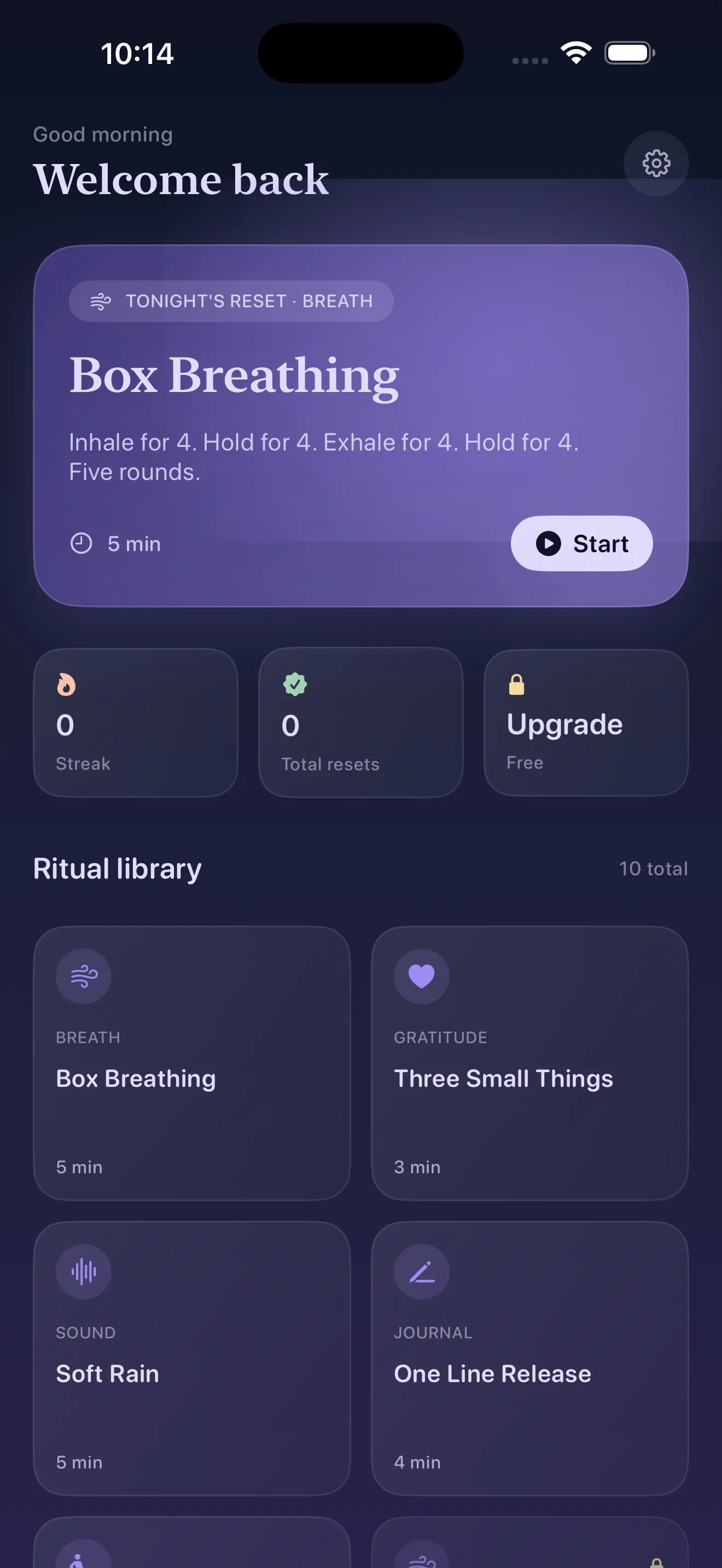
A short preview screen let her see what she was about to do before committing to it — no surprises, no fifteen-minute session disguised as a quick one. Then it moved her straight into the ritual player.
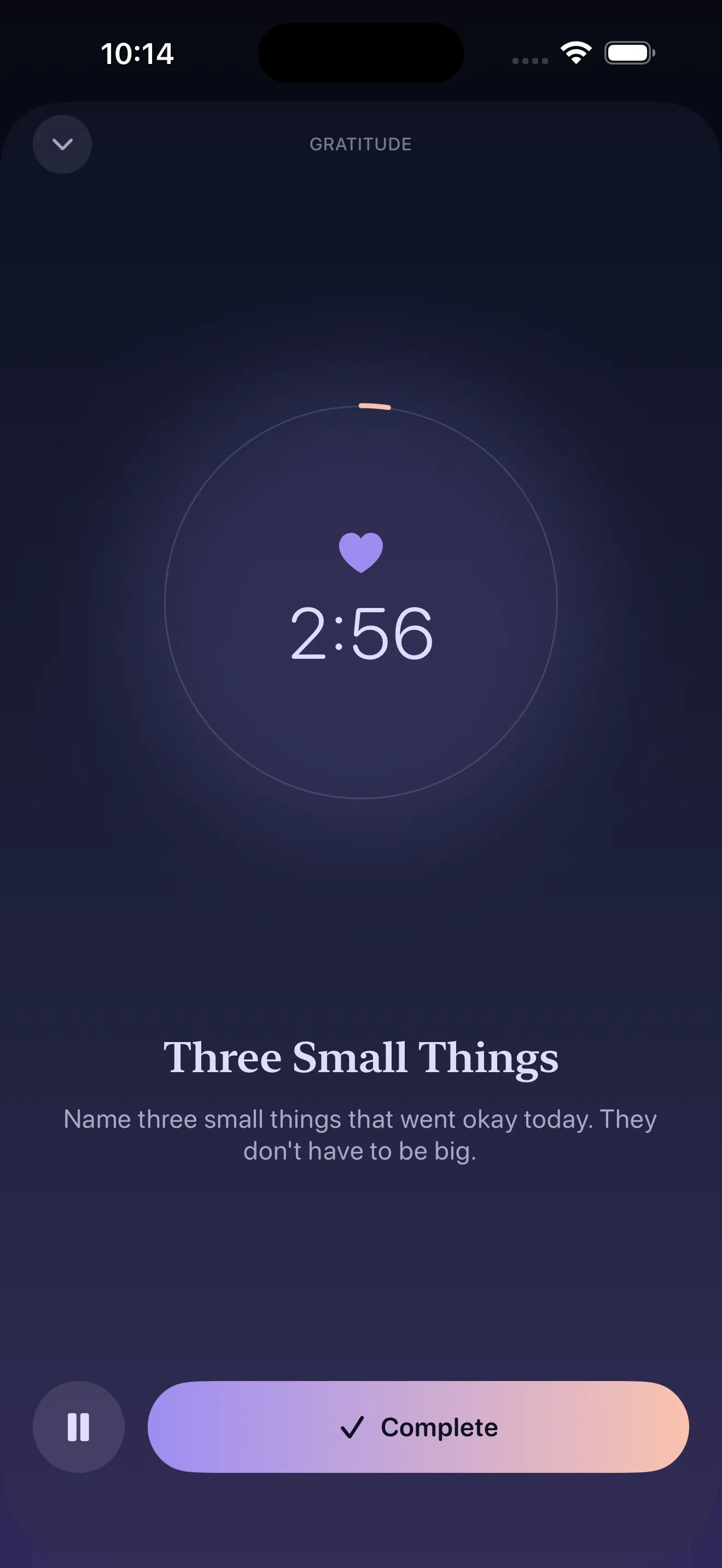
Step 1: Let the orb set the pace, not your willpower
Turning off a shift that doesn't want to end
The specific ritual matters less than the fact that one is always waiting. Some mornings after a hard shift, Maya picks a soundscape and just lies there. Other mornings she journals two lines about one thing that didn't go badly. The variety across breathwork, gratitude, soundscapes, journaling, and gentle stretches means the ritual can match her state instead of demanding she match its. For a deeper look at how these rituals get chosen night to night, this guide to building the habit walks through the mechanics.
No streak to grieve
The detail that kept Maya from quitting a fourth time was the streak itself — or rather, how it's counted. Reset tracks the good nights and quietly skips over the missed ones instead of resetting a counter to zero and making her start over. There's no flame that goes dark, no guilt-shaped notification waiting for her. On weeks with four night shifts in a row and almost no evening at all, that difference is the whole reason she's still opening the app three months later.
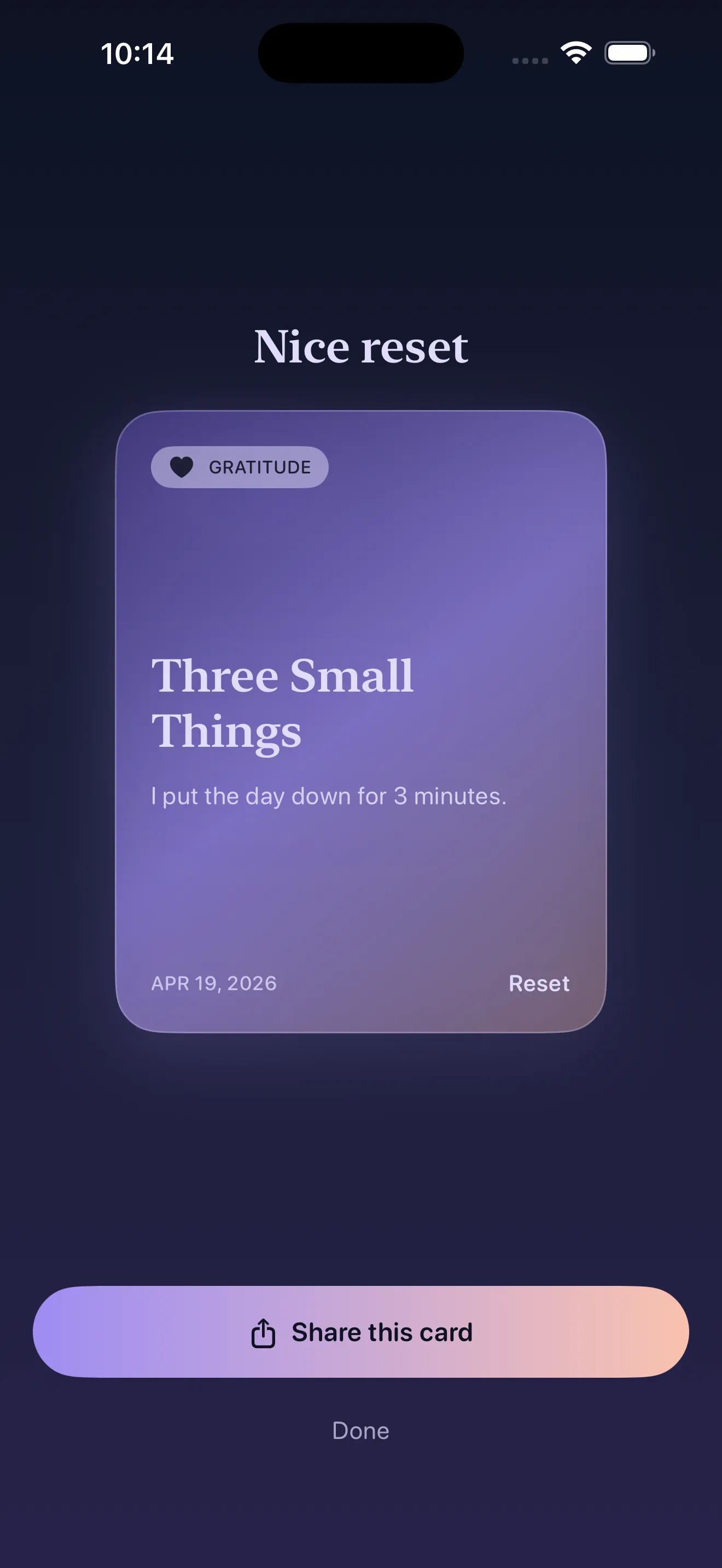
When she does have a genuinely good night — the kind where the five minutes actually settle something — she'll sometimes save it as a Reset Card, a quiet way to mark it without turning it into a public post. It's less performance, more proof to herself that the ritual is working.
What makes Reset different for irregular schedules like shift work?
What changed, three months in
Maya still can't sit through a forty-minute guided meditation, and she's stopped trying to. What she has instead is a five-minute stop between the shift and the bed — long enough to put the day down, short enough that skipping it once doesn't unravel the habit. If you're weighing Reset against longer, more traditional wind-down apps, this comparison of five minutes versus five hours covers the tradeoffs in more detail, and the guide to choosing a nightly wind-down app is a useful starting point if you're not sure what to look for.
- One ritual a night, already chosen — no decision fatigue at the worst possible time
- Sessions built to take about five minutes, not forty
- A streak that counts good nights instead of punishing missed ones
- A library spanning breathwork, gratitude, soundscapes, journaling, and stretches
- Reset Cards for marking a good night privately, without turning it into a post
Common questions
Is Reset only for people with irregular schedules like shift work?
What happens if I miss a night on Reset?
Do I need to pick which ritual to do each night?
This article was drafted with AI assistance and reviewed by a human editor before publishing.