You hit a number on the bar. Now what? A raw weight tells you almost nothing on its own; a 225-pound bench is remarkable for a 140-pound lifter and unremarkable for a 240-pound one. That's the problem a strength standards percentile is built to solve: it takes your lift, your bodyweight, and sometimes your age and sex, and places the result against thousands of real, judged competition lifts so you get an honest answer instead of a guess. Here's how to use one well.
Know What "Good" Actually Means Before You Compare
"Good" only means something relative to a group. Gym forums love to argue over a flat number, but the more useful question is: good compared to whom? A percentile answers exactly that. It says, of everyone who has lifted at a sanctioned meet, this is roughly where you fall. That's the entire premise behind Benchmark: enter a bench, squat or deadlift, and it places the number against 1.8 million judged competition lifts rather than leaving you to eyeball a chart taped to a gym wall.
Score Your Lift Relative to Your Bodyweight, Not in Isolation
Federations solved this problem decades ago by building bodyweight-relative formulas, and the formulas themselves have changed recently. The IPF retired the long-standing Wilks score and adopted IPF GL Points for all sanctioned events starting 1 May 2020, using separate exponential coefficients for men and women, raw and equipped. Most non-IPF US federations, including USA Powerlifting and USPA, moved to DOTS around the same time. Different federations, different math, same underlying idea: strip out bodyweight so lifters of any size can be ranked fairly.
- Wilks: the legacy formula, largely phased out of official use but still floating around old gym charts
- IPF GL Points: the current standard for IPF-sanctioned meets since May 2020
- DOTS: the relative-strength score used by most non-IPF US federations
A 225-pound bench means something different at 150 pounds bodyweight than it does at 250.
Understand Why Your Gym PR and a Meet Lift Aren't the Same Lift
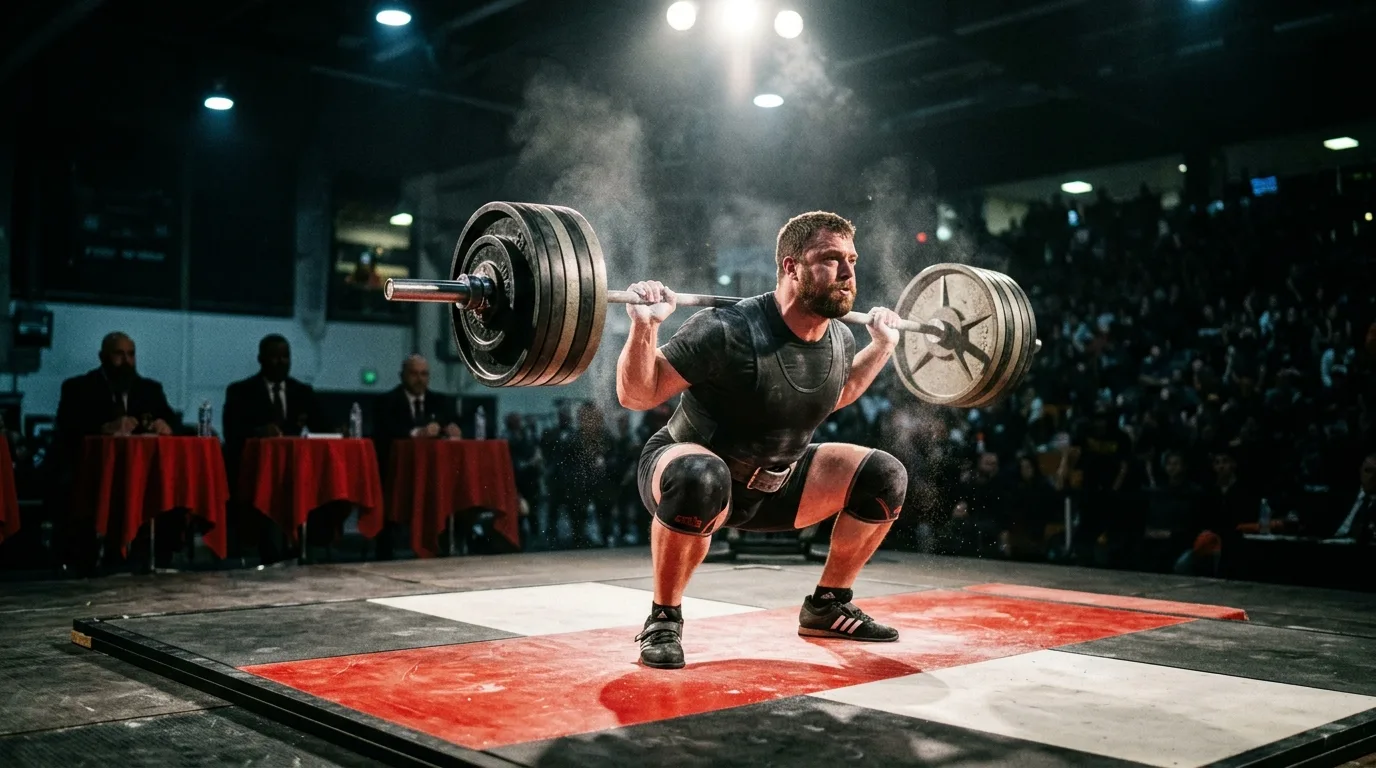
A lot of the disagreement between "what I lift at the gym" and "what counts at a meet" comes down to rules most lifters never read. Competition squats require the hip crease to drop below the top of the knee; competition bench press requires the bar to become fully motionless and wait for a judge's press command before you can drive it up, per the IPF Technical Rulebook. Skip the pause, cut the depth, and the number on the bar stops being comparable to the data judged lifts are drawn from. This is also why estimated one-rep-maxes, extrapolated from a set of five or eight reps, are risky inputs: a 2024 review found some formulas reasonably tight for bench press but wildly off elsewhere, with one common squat equation carrying a bias of −14.1 kg and 95% limits of agreement spanning roughly +38 to −66 kg, according to Ribeiro et al., 2024. If you want the full breakdown of where standards actually come from and which ones deserve your trust, see Where Strength Standards Actually Come From.
- Estimated 1RM bias, squat (Brzycki equation)
- −14.1 kg (95% LOA +38.2 to −66.4 kg)
- Estimated 1RM bias, bench (Lombardi equation)
- 0.1–0.4 kg (95% LOA ~±3 kg)
- Benchmark's percentile data source
- 1.8 million judged competition lifts
Track Percentile Drift, Not Just the Number Going Up
Weight on the bar climbs almost by default if you keep training and eating enough. The harder question is whether your percentile is climbing with it, or whether you're just getting heavier at the same rate as everyone else in the dataset. That gap is what percentile drift tracks: the honest line showing whether your relative standing is actually improving, holding steady, or quietly slipping even as your top number goes up. It's a small habit shift, but a useful one, especially if you're newer to structured training. If you're still getting oriented, the Beginner's guide category is a good place to start.
Trust a Big, Verified Data Set Over Estimates and Gym Tables
The dataset behind a percentile matters as much as the formula. OpenPowerlifting, the open-data project many strength calculators pull from, is public domain and has grown past 4 million entries from tens of thousands of sanctioned meets, according to its own live status page. That's a meaningfully larger and more verified pool than the self-reported gym tables that circulate online, where nobody checked your squat depth or your bench pause. It also lines up with a sport that's genuinely growing: US gym membership hit a record 81 million in 2025, with free-weight use growing faster than any other equipment category, per the Health & Fitness Association, while women's share of first-time competitive powerlifters has climbed from under 20% in 2010 toward roughly 31% in 2023, per Powerlifting in Data. For a worked example against a specific number, see Is a 100 kg Bench Press Good?, and for a broader look at how different tools stack up, the Comparison category is worth a browse.
Is a bigger lift always a better percentile?
Check for Free and Skip the Subscription Fatigue
Fitness apps are one of the highest-churn subscription categories around, and subscription fatigue is measurably rising, with 41% of consumers now reporting it, up from 35% a year earlier according to Adapty. Benchmark's bench press check is free forever, with no trial clock and no cap on how many times you use it, because the percentile engine ships as precomputed curves and runs as a sub-millisecond, on-device lookup rather than a network call. That also means no account to create, nothing to sync, and the whole app works in airplane mode. Browse more on the topic in all Benchmark articles.
Common questions
What is a strength standards percentile?
Why does my gym max not match a meet-legal lift?
Does tracking percentile mean logging every workout?
Sources
- IPF GL Formula
- 2026 IPF Technical Rulebook (effective 01 March 2026)
- DOTS Calculator — adoption history
- OpenPowerlifting Status
- Accuracy of 1RM Prediction Equations Before and After Resistance Training in Three Different Lifts
- 81 Million Americans Were Members of a Fitness Facility in 2025
- Young Women are Starting Powerlifting in Record Numbers
- Subscription Fatigue: Reasons and How to Prevent It
This article was drafted with AI assistance and reviewed by a human editor before publishing.