
Every household runs on two kinds of labor. One is visible: dishes washed, laundry folded, groceries carried in. The other happens before any of that — noticing the fridge is nearly empty, deciding what to cook, remembering the pediatrician appointment exists at all. Couples have spent a decade arguing about the first kind. New research makes clear the second kind is the one that actually breaks marriages, and it's the one chore charts were never built to touch.
The chore chart problem
A chore chart assumes the hard part is doing the task. Split the doing 50/50 and you've solved it. But a 2024 study in the Journal of Marriage and Family found mothers report primary responsibility for 79% of daily cognitive labor — cleaning, scheduling, food, childcare — versus 37% for fathers, while fathers' contribution concentrates almost entirely in episodic, deferrable domains like home maintenance and finances, at 65% versus 53% (Journal of Marriage and Family). The same study found fathers overestimate their own cognitive-labor share by 16 percentage points against task-based measures, versus a 7-point gap for mothers. That's not a fairness problem you can fix by adding more columns to a whiteboard. It's a visibility problem — and it's why FairShare was built around cards instead of charts.
What 'cognitive stickiness' actually means
The most striking finding in this space arrived in October 2025. Researchers from the University of Bath and Melbourne tracked partnered U.S. parents and found mothers hold an average of 13.72 concurrent mental tasks compared to 8.2 for fathers — 67% more household management, concentrated in scheduling, social relationships, and food planning (University of Bath). Here's the part that matters most: high-earning mothers do 30% less childcare and 17% less housework than lower-income mothers, but their mental load tasks don't drop at all. The researchers call this gendered cognitive stickiness — cognitive labor sticks to women and is rarely renegotiated, no matter how much execution gets outsourced or delegated.
Money can buy a mother out of laundry. It doesn't buy her out of remembering the pediatrician appointment.
Full ownership: Conceive, Plan, Execute
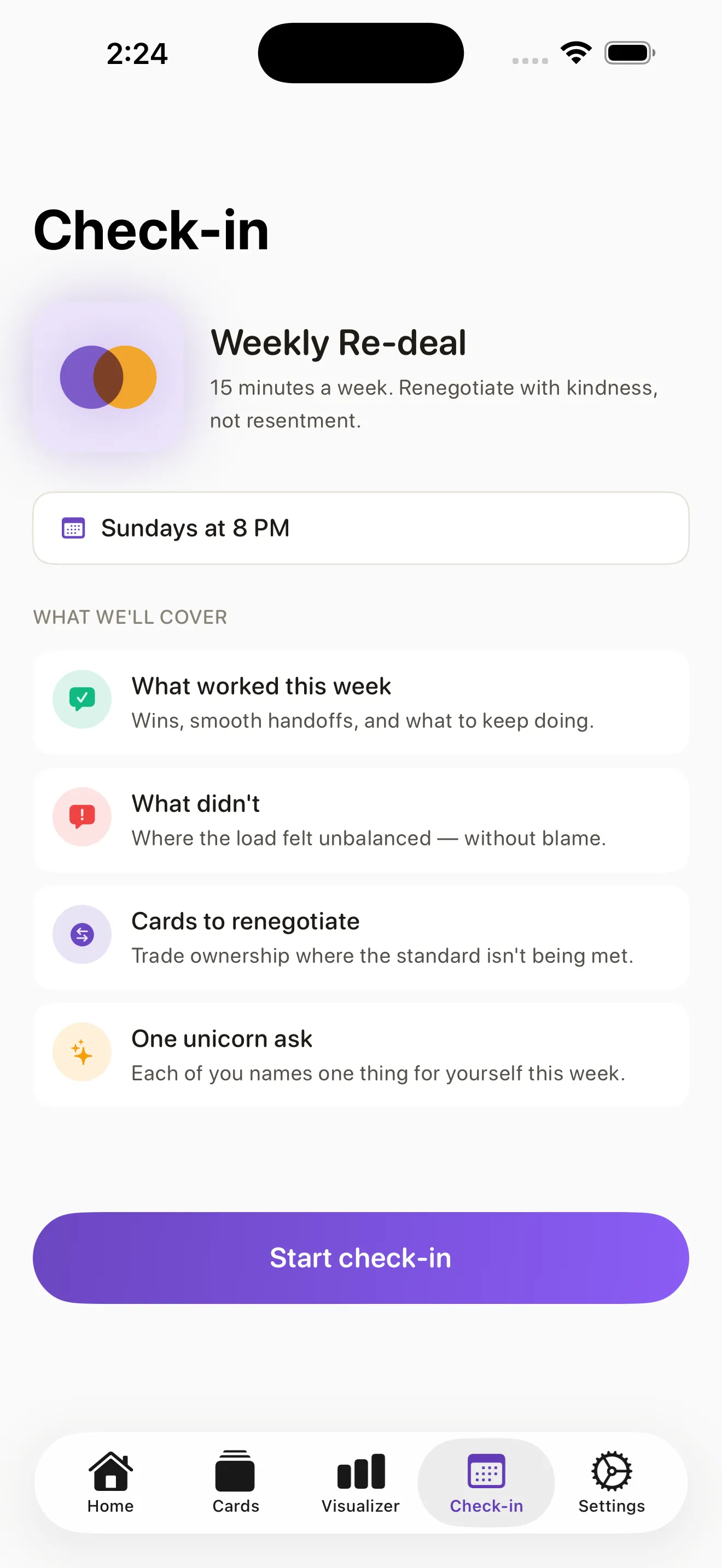
This is the gap FairShare's card system is built to close. Every card in the household carries CPE ownership — Conceive, Plan, and Execute — meaning one person is fully responsible for noticing the need exists, deciding how to handle it, and following through, start to finish. Nobody is 'helping.' Nobody is assigned a task that someone else already thought through. If you own the 'kids' clothes' card, you're the one who notices the growth spurt, decides what to buy, and handles the order — not the person reminded to pick up a package. That structure borrows directly from the Fair Play method, but turns it into something you actually maintain instead of a deck of cards in a drawer.
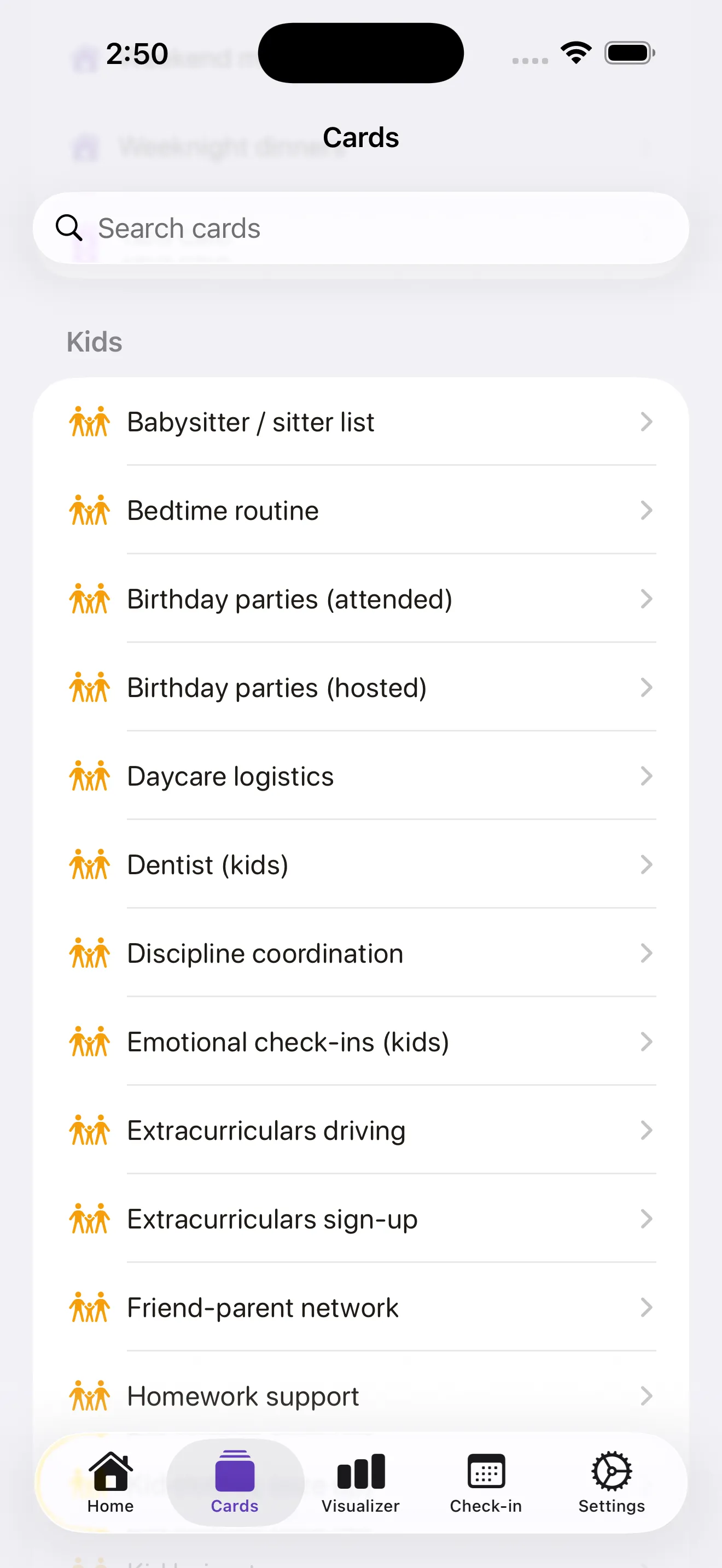
Brain Dump: catching the load before it becomes resentment
Most mental load doesn't announce itself as a task. It shows up as a stray thought at 11pm — we're almost out of the kid's allergy medicine — that either gets acted on silently by one partner or forgotten until it's a small emergency. FairShare's Brain Dump is built to intercept exactly that moment: capture the thought as it happens, and the app turns it into a structured card with a suggested owner instead of leaving it to live in someone's head. Apple's own platform direction backs this shift — at WWDC 2026, natural-language capture and cross-app context became first-class iOS capabilities, and user expectations for turning spoken thoughts into structured action moved with it (TechCrunch).
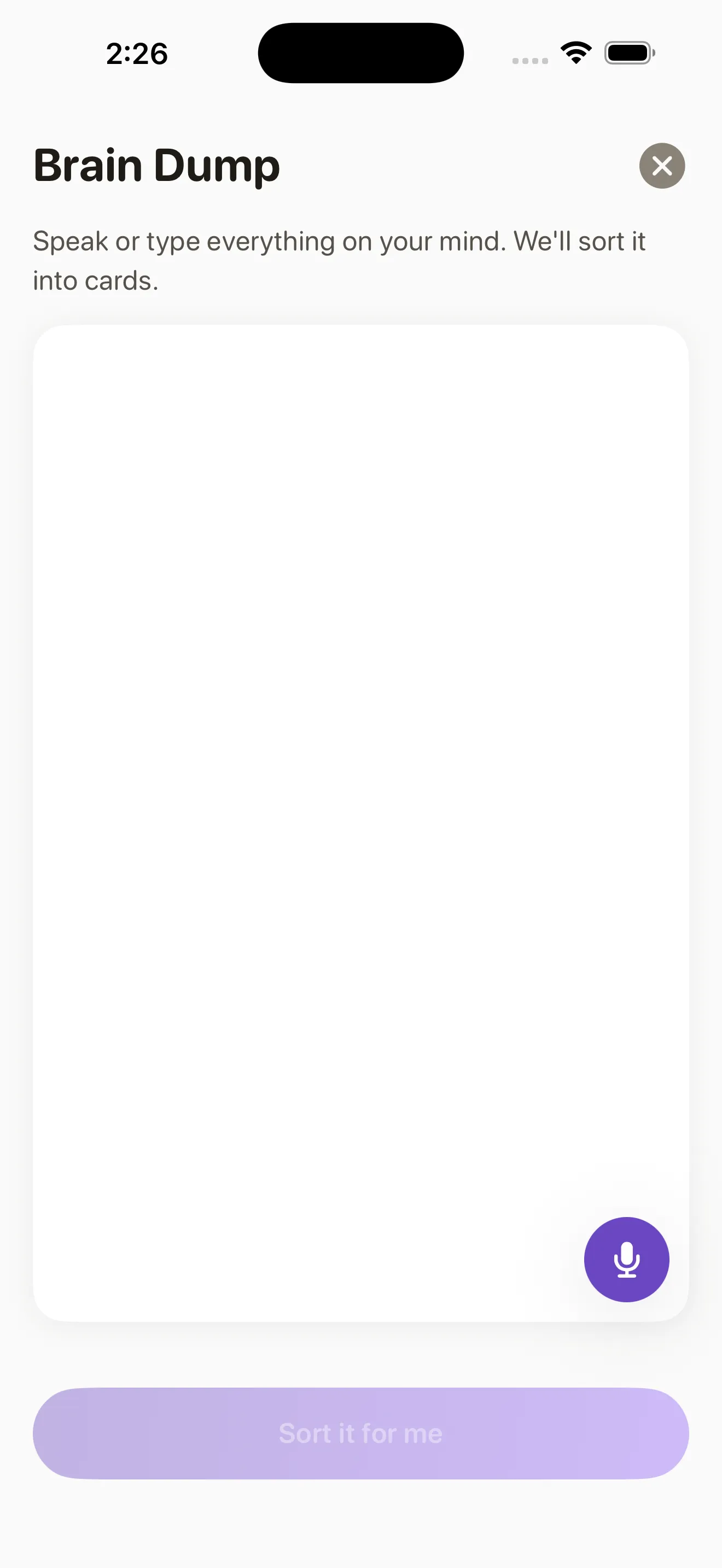
The visualizer: making the invisible countable
Sociologist Allison Daminger's research on cognitive labor found that heterosexual couples split it roughly 80/20 even when both partners genuinely want equality — and that couples tend to explain the gap away as personality, not structure (Wisconsin Public Radio). That's the trap: imbalance is easy to rationalize when it's invisible. FairShare's Visualizer exists to remove the rationalization. It renders the household's card ownership as an actual breakdown — who holds how much, and where — so a conversation that used to start with 'it feels like I do everything' can start with a number instead.
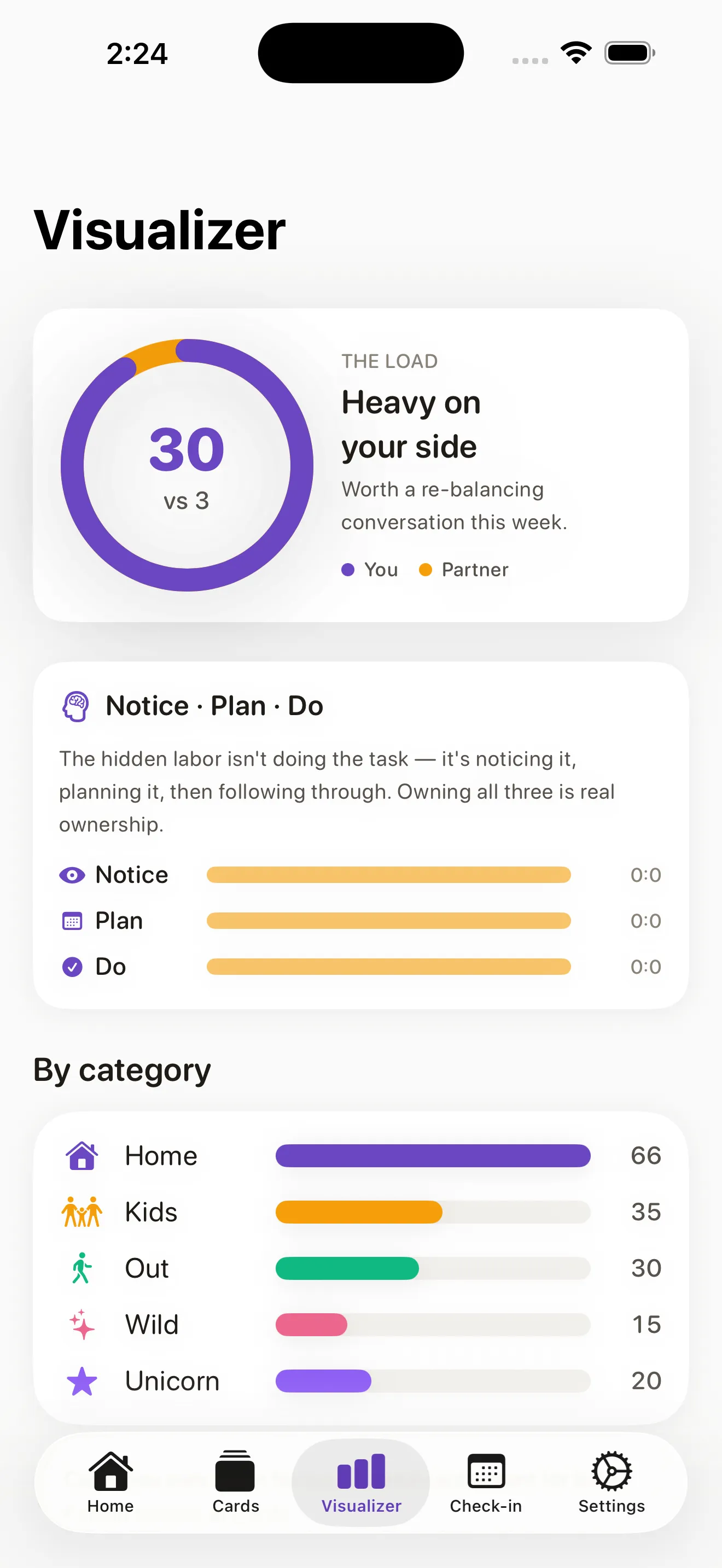
Weekly check-ins: renegotiation without waiting for a fight
Ownership that never gets revisited turns stale — life changes and cards need to move. FairShare's weekly check-in is a short rhythm of prompts covering what shifted, proposed swaps, minimum standard of care updates, and open renegotiations, so imbalance gets addressed on a schedule instead of during an argument. This is the same principle behind USC's eight-week Fair Play-based program: 73% of mothers in that study reported owning all conception and planning labor going in, and after structured redistribution, 61% of participants reported a more balanced household (USC Public Exchange). Structure, applied regularly, is what actually moves the needle — not intention. If you're inviting a partner into the household for the first time, the invite flow is designed to get both people into the same shared view fast, since the whole system only works when ownership is visible to both sides.
Common questions
Do I need to read the Fair Play book to use FairShare?
What makes CPE ownership different from just splitting chores 50/50?
Is FairShare only for opposite-sex couples?
Sources
- Successful career women still shoulder the majority of the 'mental load' at home: new research
- A typology of US parents' mental loads: Core and episodic cognitive labor
- Balancing mental & physical labor in the home
- Women carry a household's mental load. Now, a Wisconsin researcher has receipts.
- WWDC 2026: Everything announced on Siri AI, iOS 27, Apple Intelligence, and more
This article was drafted with AI assistance and reviewed by a human editor before publishing.