
Ask any couple why their chore chart quietly died and you'll hear some version of the same story: it worked fine until someone had to notice the chart needed updating, decide what counted as fair, and remember to bring it up again. That noticing, deciding, and remembering is the mental load, and it never shows up on a chart because charts only track the doing. FairShare was built around a different unit of work entirely: the full arc of a task, from the moment someone first thinks of it to the moment it's finished.
The Chore Chart Trap
Most attempts to split housework fairly start with a list of tasks and end with an argument about who did more. The list feels objective, but it hides the part that actually exhausts people: deciding the list needs to exist, keeping it updated, and holding the standard for what "done" looks like. A chart can tell you who ran the dishwasher. It can't tell you who noticed it needed running, who decided when, or who'll notice again next time. Splitting chores fairly starts with admitting that execution is the smallest, most visible piece of the work.
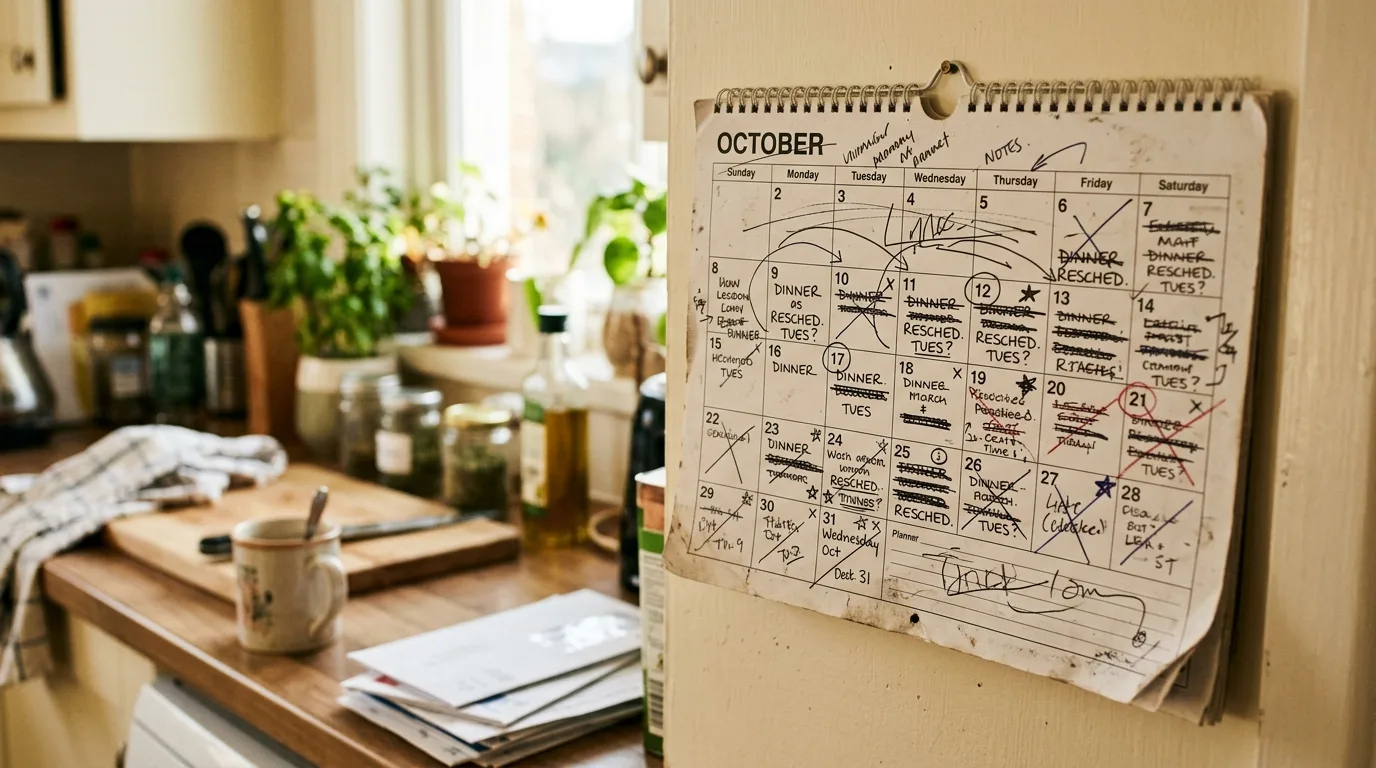
This is why so many well-intentioned systems collapse within a few weeks. They redistribute tasks but leave the invisible layer — the conceiving and planning — sitting with whoever was already carrying it. The imbalance doesn't go away. It just gets harder to point to.
Full Ownership, Not Half a Task
FairShare's cards are built on the idea that every piece of household work has three stages, and splitting a task in half without splitting all three just moves the exhausting part around. CPE ownership means one person holds a card completely.
- Conceive — noticing the need exists before anyone else does
- Plan — deciding how, when, and to what standard it gets done
- Execute — actually doing the task, start to finish
What does CPE ownership mean in FairShare
A task split by vibes always drifts back to whoever was already carrying it. A task split by CPE has nowhere to hide.
- Chore chart
- Assigns who executes a task, nothing else
- FairShare card
- Assigns full ownership of noticing, planning, and doing
- Chore chart failure mode
- Reassignment fights when one person 'forgets' again
- FairShare failure mode
- Explicit renegotiation during a weekly check-in
The Brain Dump Problem
The hardest part of adopting any ownership system is the onboarding conversation itself. Sitting down to sort a household's entire mental load into cards is exactly the kind of open-ended planning work that mental load already punishes one partner for avoiding. FairShare's Brain Dump exists to shortcut that: it intercepts the scattered, half-finished list already living in someone's head — texts to send, appointments to book, things half-remembered at 11pm — and helps sort it into cards instead of leaving it as background noise. It's less a to-do list and more a way of getting the invisible list out of one person's head and onto a shared board, grounded in the same Fair Play card system that inspired the household types in the first place.

Weekly Check-Ins Instead of Blowups
Ownership isn't static. Seasons change, jobs change, kids grow, and a card that made sense in January can feel wildly lopsided by summer. Most couples don't renegotiate on a schedule — they renegotiate mid-argument, which is the worst possible time to be fair to each other. FairShare's weekly check-ins are short, structured prompts: what shifted this week, what needs to swap, whether the household's minimum standard of care still holds, and whether any card needs to change hands. The goal isn't more meetings. It's moving the renegotiation conversation out of the fight and into a rhythm.
Making Imbalance Visible
Even with cards and check-ins, imbalance can still hide in plain sight if nobody's looking at the whole board. The visualizer takes every card a household holds and turns ownership into something you can actually see, so a lopsided split shows up as a shape, not a suspicion. That's a meaningfully different starting point for a conversation than "I feel like I do more," which is where most of these conversations go to die.

None of this works without both partners actually in the app, which is why getting the invite right matters more than it sounds like it should. Inviting a partner into a household app needs to feel like opening a shared board, not sending homework.
Common questions
How is FairShare different from a shared chore app
Do both partners need the app for it to work
What happens during a weekly check-in
This article was drafted with AI assistance and reviewed by a human editor before publishing.