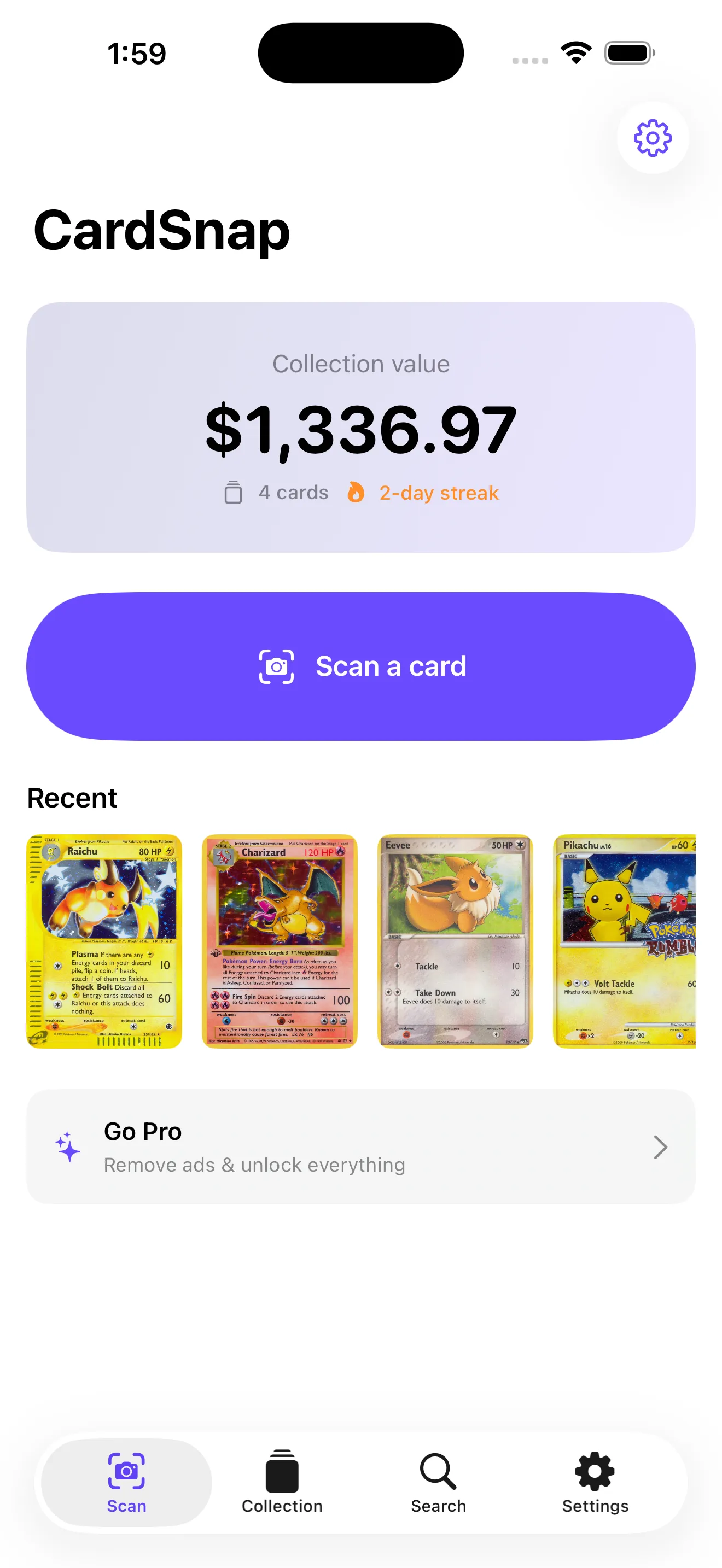
Ask a room full of collectors what a card is worth and you'll get a room full of different answers. Not because anyone's wrong — because 'worth' isn't a fixed fact, it's a moving target shaped by which marketplace you're looking at, what condition you're grading, and what day you're checking. CardSnap was built around that reality instead of pretending it away. The app doesn't hand you a single number and call it done. It hands you a range, a source, and a date, and lets you decide what to do with it.
A Price Is a Snapshot, Not a Fact
The moment you scan a card, CardSnap shows you three figures: a low, a market, and a high. That's not indecision — it's the actual shape of a real market. A card's low price might reflect a rushed seller clearing inventory, while its high reflects someone patient enough to wait for the right buyer. The market price sits in between, closer to what most transactions actually settle at. Showing all three, instead of averaging them into one tidy figure, gives you something closer to the truth: a range you can reason about, not a false certainty you have to trust blindly.
Every price also carries an 'as of' date. Card markets shift week to week, sometimes day to day around a new set release or a reprint announcement. A number without a timestamp is just a rumor. A number with one is data you can actually act on.
Two Markets, One Card
CardSnap pulls live prices from both TCGplayer and Cardmarket, because a single-market view only tells half the story for most collectors. TCGplayer prices lean toward the US market; Cardmarket reflects European trading. If you're buying, selling, or just curious how far your collection would travel in value, seeing both side by side matters more than seeing either one dressed up as the definitive answer.
A single price feels authoritative. A range feels honest. CardSnap is built for the second kind of trust.
This is also where the free tier does real work. Scanning and text search are unlimited from your very first card, no account required and no wall in the way. You can build real judgment about what your cards are worth before you ever decide whether to unlock more. If you want the deeper layer, price history and graded PSA and CGC values, that's a paid step forward, not a paywall blocking the basics. Our guide to valuing cards with your iPhone walks through how to read those numbers once they're on screen.
What Happens On Your Phone Stays On Your Phone
Card recognition runs on-device. When you point your camera at a card, CardSnap identifies it without sending the image off to a server somewhere to be processed, logged, or repurposed. Only the lightweight lookup, matching the card to its live price data, touches the network. Your camera roll, your scanning habits, and the contents of your binder stay yours. For a hobby built on personal collections, sometimes worth real money, that boundary isn't a nice-to-have. It's the baseline.
From One Card to a Whole Binder
A single card's value is a fun fact. A whole collection's value is a different kind of information — it's the number that tells you what years of pulling packs, trading with friends, or hunting singles actually added up to. CardSnap's collection tracker totals every card you've logged into one running figure, updated as prices move, so your binder's worth isn't a guess you make once and forget. It's a live total that changes as the market does.
- Streaks and value milestones turn tracking into a habit instead of a chore
- CSV export (unlocked) lets your data leave the app whenever you need it elsewhere
- Price alerts (unlocked) tell you when a card you're watching moves
If you're just getting started, the first-scan walkthrough covers the basics end to end, and our beginner's guide collects everything new collectors tend to ask first. Once scanning feels automatic, the collection tracker guide is the natural next stop for turning a pile of cards into an organized, valued binder.
This article was drafted with AI assistance and reviewed by a human editor before publishing.