
Every household runs on two kinds of labor: the work you can see, and the work someone is quietly tracking in their head. Fair Play, the card-based system created by Eve Rodsky, was the first framework to give that second kind of labor a name and a structure. It's held up remarkably well under research. What hasn't held up is the physical deck itself. Most couples who try it stop within weeks — not because the idea failed, but because index cards can't send a reminder, can't log a swap, and can't tell you when the system has quietly drifted back to one person. FairShare starts from that gap: keep the framework, fix the format.
What is the Fair Play framework, in one sentence
The framework was never the problem
Fair Play's 100-card deck, split into core household tasks, tasks tied to raising kids, and daily-grind essentials, isn't a chore chart wearing a new outfit. Each card is structured around Conception, Planning, and Execution — the idea that whoever notices the pediatrician appointment is due should also be the one who books it and shows up, instead of handing off the doing while still holding the remembering. That structure maps almost exactly onto sociologist Allison Daminger's earlier research, which found that in roughly 80% of different-sex couples studied, women carried the bulk of the household's cognitive project management — the noticing, anticipating, and deciding, not just the doing.
A more recent measure puts a sharper number on it: a 2024 study found mothers manage 71% of household cognitive tasks on average. Separately, Australian research found women in dual-income households still carry about 65% of family mental labor, spending 21 hours a week on unpaid household management against 8 for men. The imbalance isn't a perception problem. It's a documented, repeated finding across a decade of research, which is exactly why a framework built to redistribute it deserves better tooling than a box of cards.
Where the physical deck falls apart
A 90-day test of the physical Fair Play deck found what a lot of couples already suspected: most drop the system by week four to six, even when they genuinely believe in it. The same review names four predictable failure points — conflict when a card gets dropped, one partner's buy-in quietly fading, check-ins that get skipped and never rescheduled, and arguments over what actually counts as an acceptable 'minimum standard of care' for a task. None of those failures are about the framework being wrong. They're about a system with no memory, no nudges, and no way to see drift happening in real time.
A stack of cards can tell you who owns dinner tonight. It can't tell you that ownership has quietly shifted back to one person over the last six weeks.
Ownership, not just visibility
This is where most competing tools split into two camps and stop. Calendar and checklist apps solve visibility — everyone can see the pediatrician appointment is on Tuesday. AI-triage and brain-dump apps solve capture — everyone can offload the thought the moment it appears. Neither solves the actual mechanism Fair Play is built around: full CPE ownership transfer, held in place over months, not just logged for a week. FairShare is built specifically for that gap, which is also the subject of a related piece on how FairShare splits mental load into ownable cards.
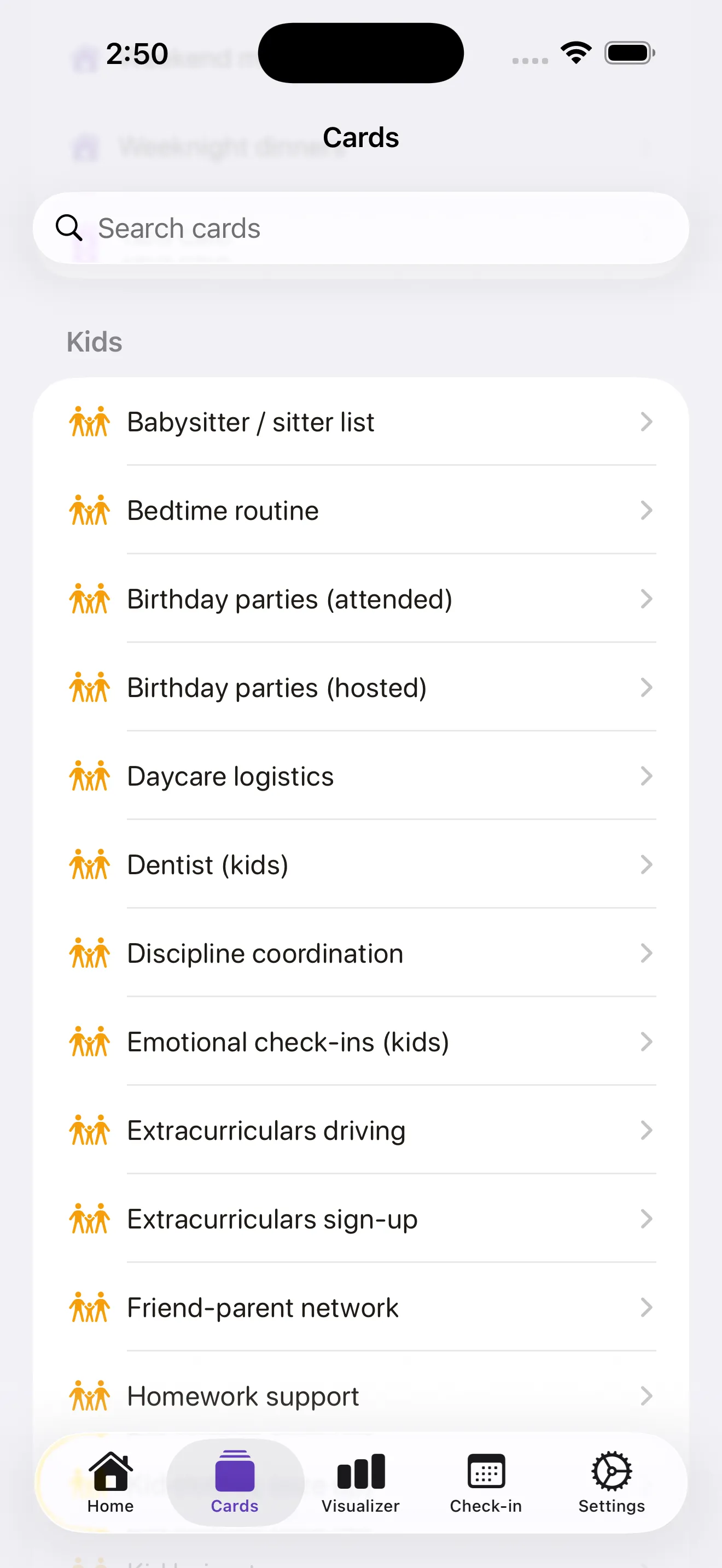
Each card in FairShare works the same way the physical deck was supposed to: whoever owns it owns conceiving the need, planning around it, and executing it — no quiet handback of the thinking once the doing is done. The composer makes that ownership explicit at the moment a card is created or reassigned, instead of leaving it as an unspoken assumption.
The Brain Dump interceptor
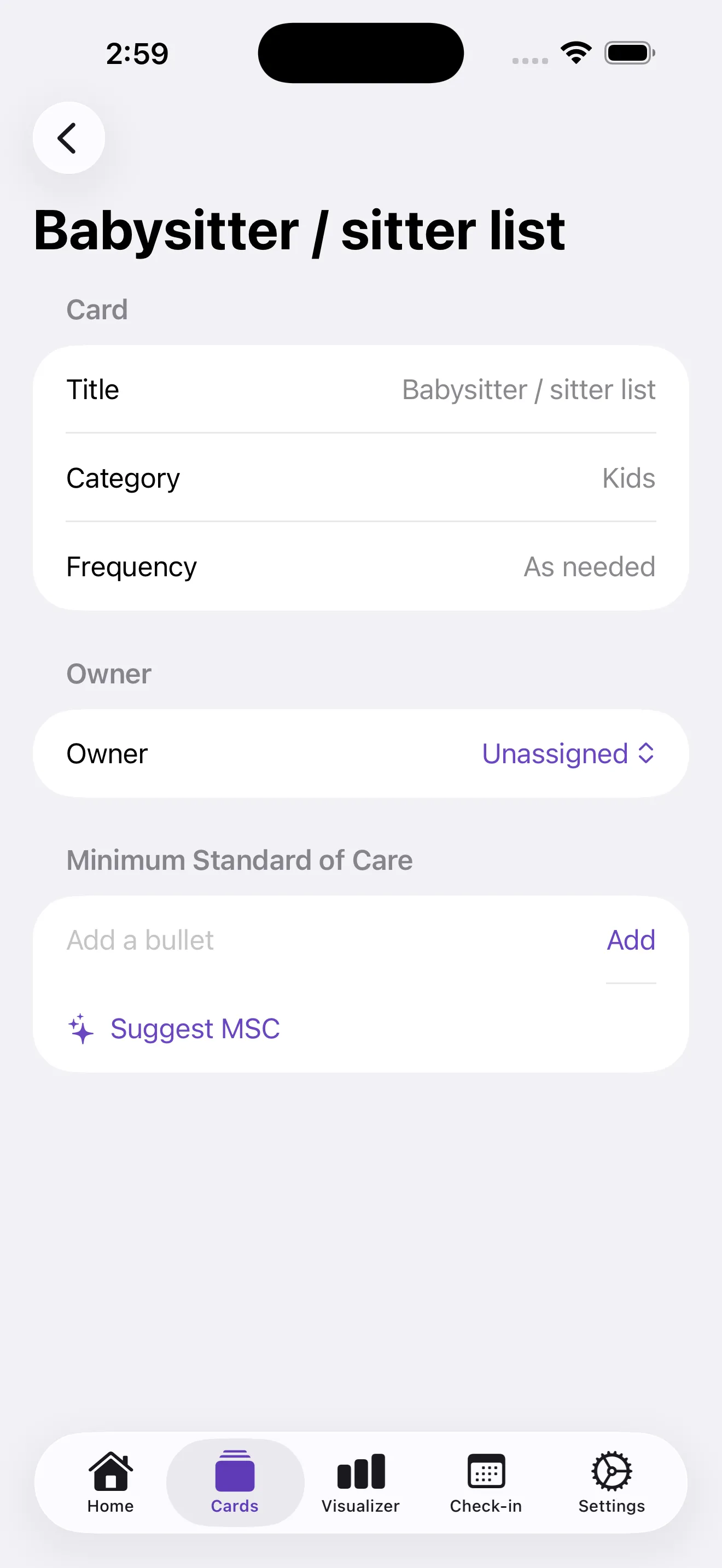
The mental load doesn't announce itself in tidy task form. It shows up as a half-formed thought at 11pm — we're almost out of the kid's allergy medicine — with nowhere to go except the same overloaded head that noticed it. A wave of newer apps has trained people to expect that thought to be captured instantly and sorted later, part of a broader shift toward AI-assisted capture-then-organize tools that turn unstructured voice or text into structured tasks. FairShare's Brain Dump does the same thing, but routes the result into the household's existing card system instead of a generic to-do list, so a fleeting thought becomes an assigned card with an owner attached — not just another item nobody claims.
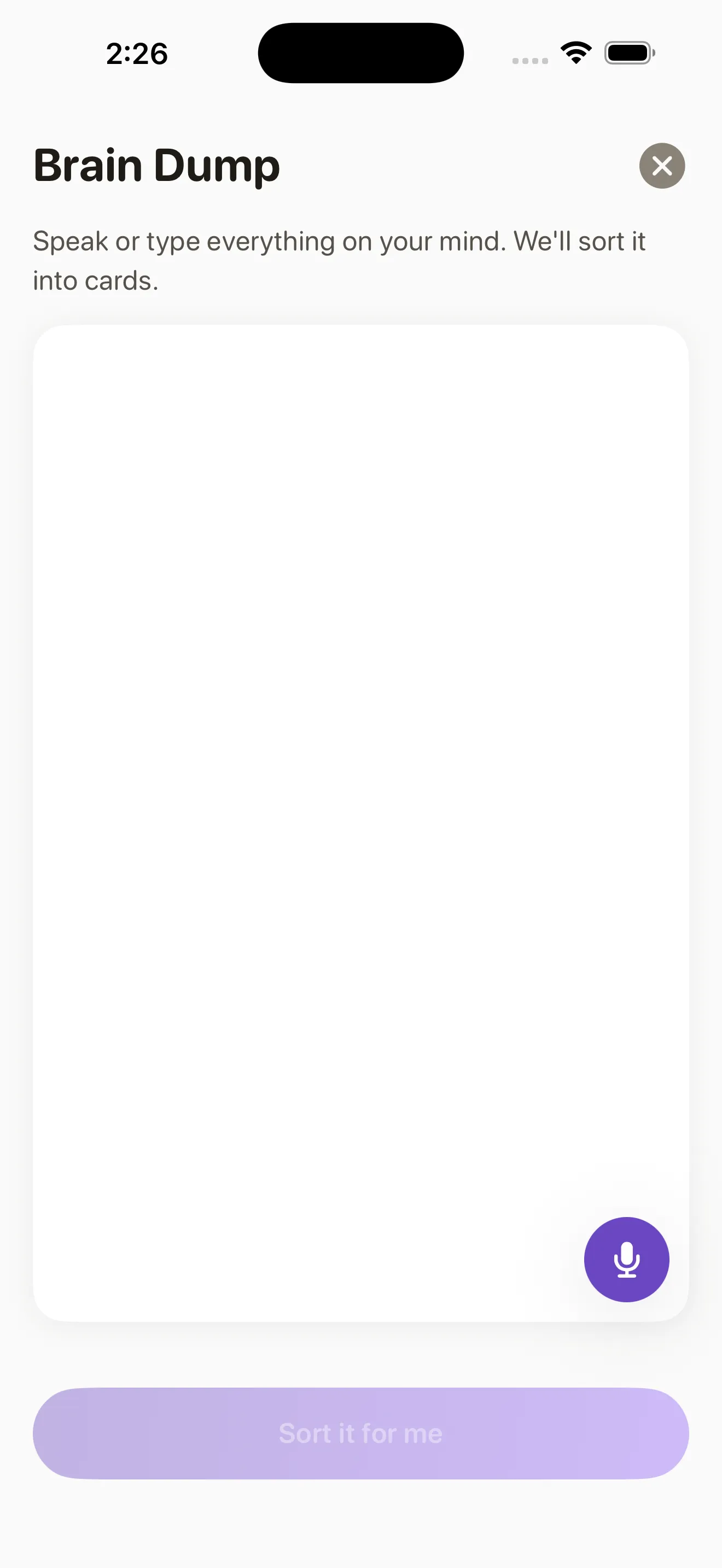
This kind of on-device, AI-assisted sorting is only getting more capable across iOS. Apple's own preview of the next generation of Apple Intelligence and Siri points toward exactly this kind of ambient capture becoming a baseline expectation, not a novelty — which is the direction FairShare's interceptor is already built for.
Making the invisible visible: the Visualizer
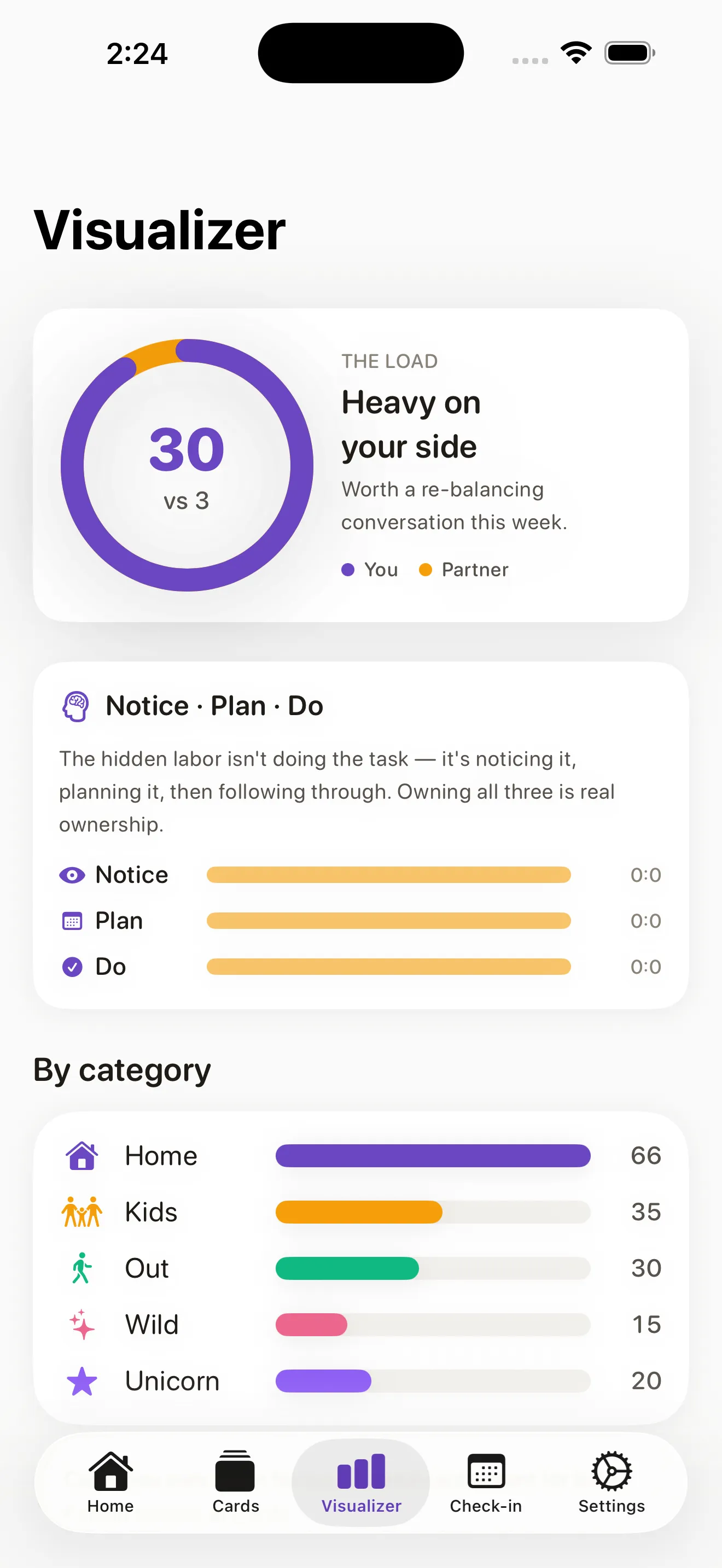
One reason mental load imbalance persists is that it's genuinely hard to see. Nobody sits down and decides to carry 71% of the household's cognitive tasks — it accumulates one unnoticed decision at a time. FairShare's Visualizer takes the CPE data already sitting inside each card and turns it into a breakdown of who's actually holding what, across conceiving, planning, and executing separately, not just a raw task count that flattens the difference between doing a load of laundry and running the entire school-supply pipeline.
This is closer to what a 2026 comparative review found when it tested seven mental-load apps across 43 households over 12 weeks: tools that scored lowest on effectiveness were calendar-only apps that show tasks but never show ownership, while tools built around genuine ownership transfer scored highest. Visibility alone doesn't rebalance anything. Visibility paired with accountability does.
- Calendar/checklist apps (visibility only)
- Scored lowest on mental-load effectiveness
- AI brain-dump apps (capture only)
- Solve offloading, not ownership
- Full CPE ownership-transfer tools
- Scored highest on mental-load effectiveness
Weekly check-ins: closing the loop the deck couldn't
Missed check-ins are one of the four documented failure points of the physical Fair Play system, and it's not hard to see why: a recurring conversation with no built-in prompt is the first thing to disappear from a busy week. FairShare's weekly check-in is short by design — a rhythm of prompts covering what shifted, what needs to be swapped, whether the minimum standard of care on a task has changed, and whether anything needs renegotiating. The point is that these conversations happen on a schedule, before resentment builds, rather than only surfacing during an argument.
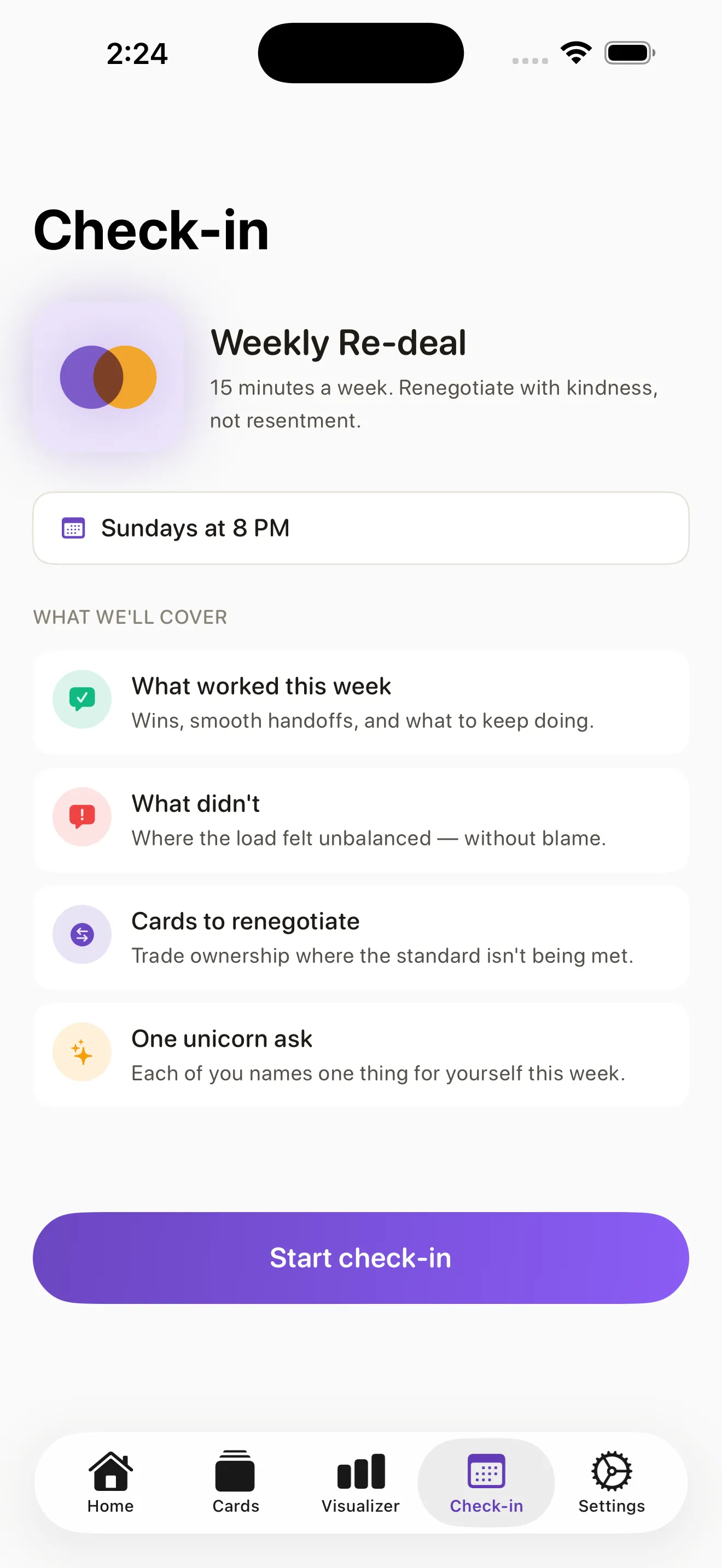
That timing matters more than it sounds. A recent survey found only 15% of U.S. adults have ever attended couples therapy, with ongoing conflict and communication struggles as the top reasons couples eventually sought it. In other words, most couples don't have a structured venue for this conversation until things are already strained. A five-minute weekly check-in is a much lower bar to clear than a first therapy appointment — and it's built to catch imbalance while it's still small.
Getting a partner in, not just yourself
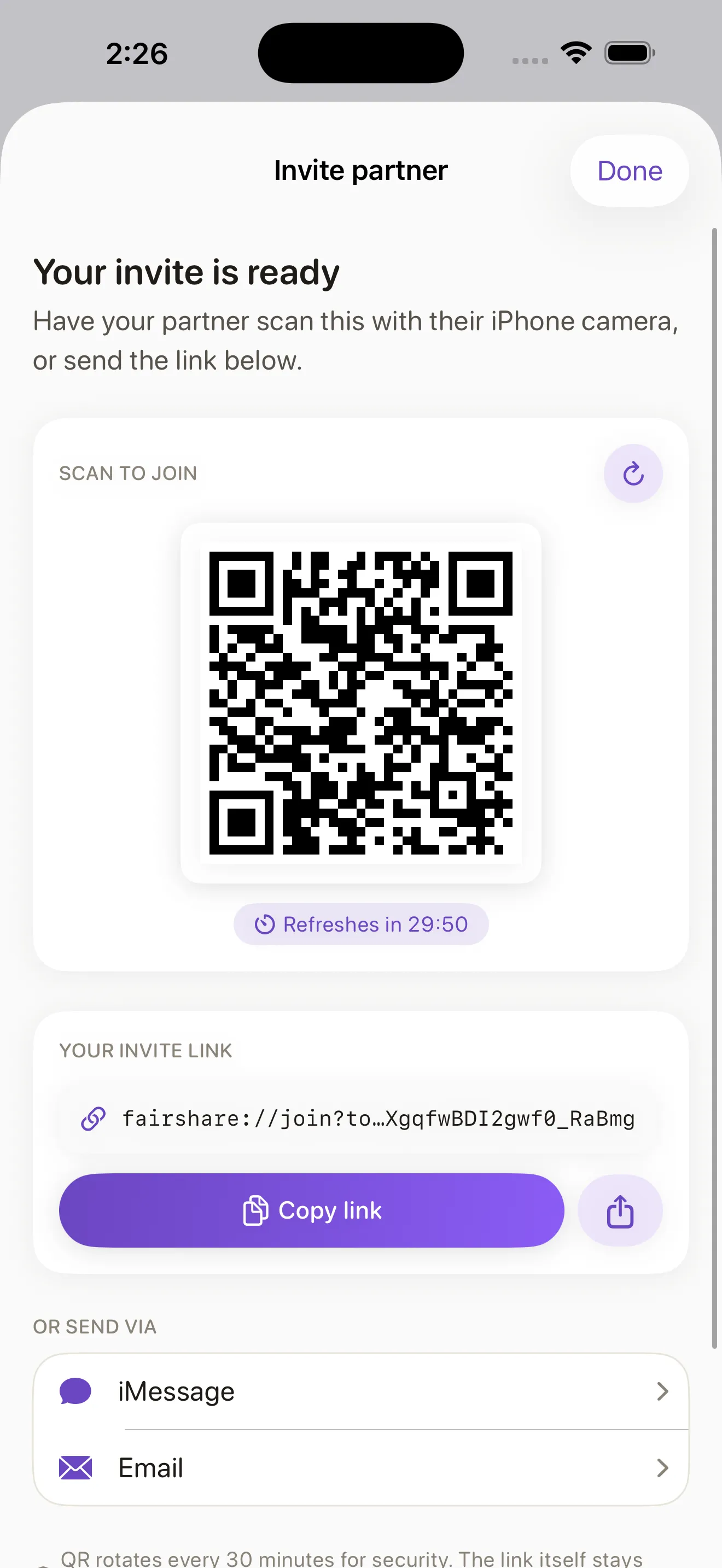
None of this works as a solo habit-tracker — the entire point is shared ownership, which means the invite has to be frictionless enough that it actually gets accepted. FairShare uses universal links that open the app directly if it's installed, with a Safari fallback and a fairshare://join scheme underneath, so a partner isn't stuck downloading an app just to see what card they've been assigned. The mechanics of that invite flow are covered in more depth in a guide to inviting a partner to a household app, and in a broader look at Fair Play on iPhone.
Common questions
Is FairShare the same as the physical Fair Play card deck?
What does CPE ownership actually mean?
Does FairShare require both partners to use the app equally?
Sources
- Rebalance and Alleviate the Mental Load at Home with the Fair Play Method
- Fair Play Method Review: 90-Day Honest Results
- How Invisible Labor Affects Relationships
- Best App for Mental Load: 7 Tested by Moms
- Mental Load in Relationships: Why It Matters and How to Share It
- Fair Play method: does splitting household cards actually work?
- Best Brain Dump Apps in 2026: 9 Tools Compared
- Apple unveils next generation of Apple Intelligence, Siri AI and more
- 2026 Couples Therapy Survey: Growing Stronger Together
This article was drafted with AI assistance and reviewed by a human editor before publishing.