
Every mental load app on the market is answering the same complaint: one partner is quietly running the household from inside their head, and no chore chart has ever fixed that. The hard part isn't dividing tasks, it's dividing the invisible work of noticing, deciding, and remembering that happens before any task gets written down. FairShare starts from a specific diagnosis of that problem — Eve Rodsky's Fair Play framework — and then asks a harder question the original card deck never fully solved: what does it actually take, in software, to move that invisible work instead of just relabeling it?
What mental load actually means, and why chore lists miss it
Fair Play's core insight, laid out across 100 task cards, is that every piece of domestic work has three phases: Conception (noticing it needs to happen), Planning (figuring out how), and Execution (doing it). Rodsky's argument, still treated as sound by researchers, is that couples who split only Execution while one partner keeps Conception and Planning haven't actually shared the load — they've just outsourced the physical labor while keeping the cognitive labor concentrated. A 2025 time-use study backs this up directly: women are significantly more likely to hold organizational responsibility for domestic tasks, and that gap shows up as measurable emotional fatigue that spills into work performance, not just household friction.
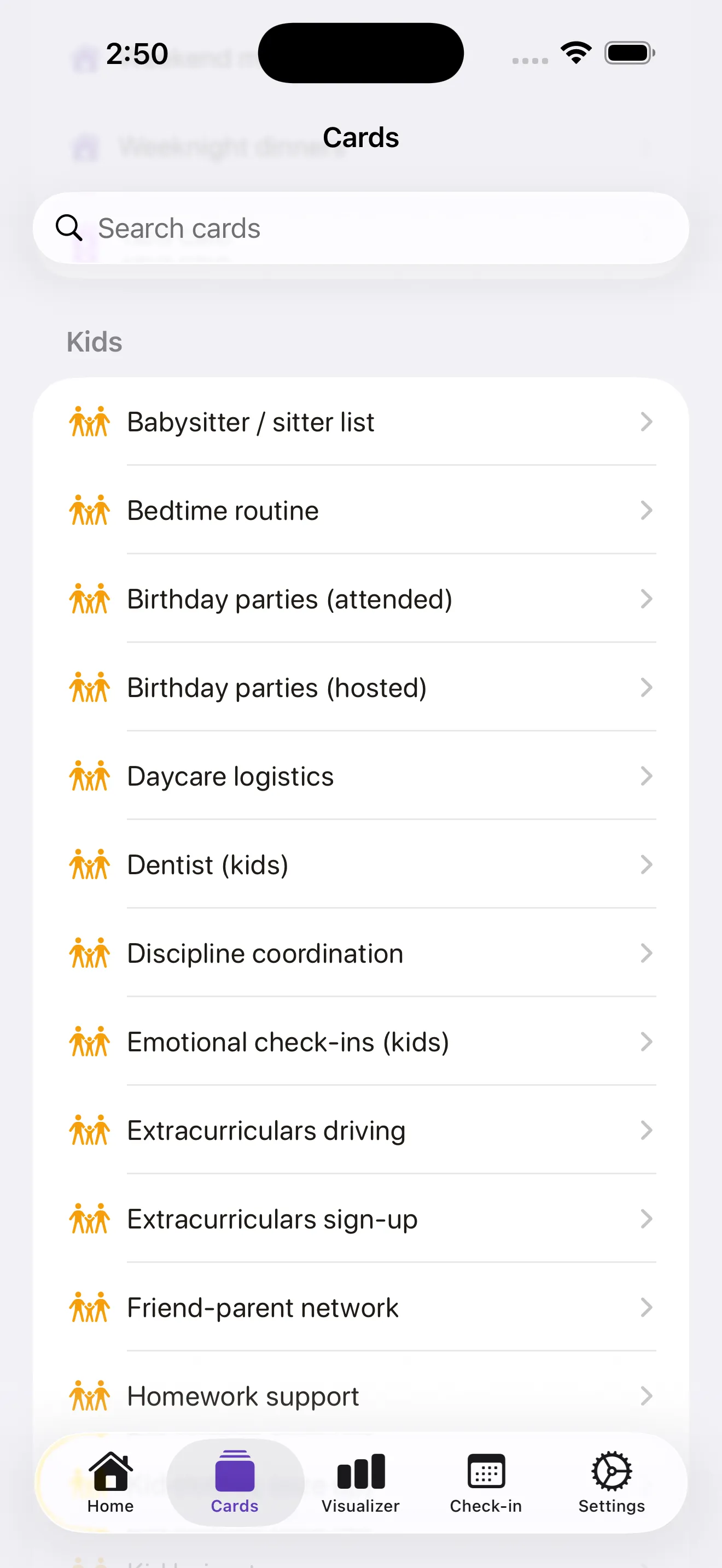
That's the gap FairShare is built around. Instead of a to-do list with two columns, its household cards carry full CPE ownership — one person owns a domain end to end, not just the doing of it. We go deeper on how that plays out card by card in how FairShare splits mental load into ownable cards.
What makes a tool a real mental load app, not just a chore app
Why physical cards recreate the problem they were meant to solve
Fair Play's 100-card deck is a genuinely useful diagnostic tool, and a USC Public Exchange study of more than 500 participants found that the more of its intervention modules people completed, the more equitable their task division became — with larger equity gains tied to reduced burnout and depression. But the same research surfaced something messier: one study cohort saw no significant change in division of labor at all, even though participants who did shift instrumental labor still reported feeling less burned out.
That split result lines up with a growing 2026 critique of the physical deck itself. A Fair Play for Chores on iPhone comparison of the format notes that couples abandon the cards for two reasons: one partner won't engage with the system at all, and the deck becomes overwhelming to actually run — 100 cards, five categories, recurring redeals to manage by hand. Worse, the critique argues that Conception and Planning quietly stay with the same partner even after a card changes hands, because nothing in a physical deck forces the new owner to actually think ahead rather than wait for the next reminder.
A card that only tracks who executed a task hasn't moved the mental load. It's just given the manager a new report to file.
The Brain Dump interceptor: catching the noticing, not just the doing
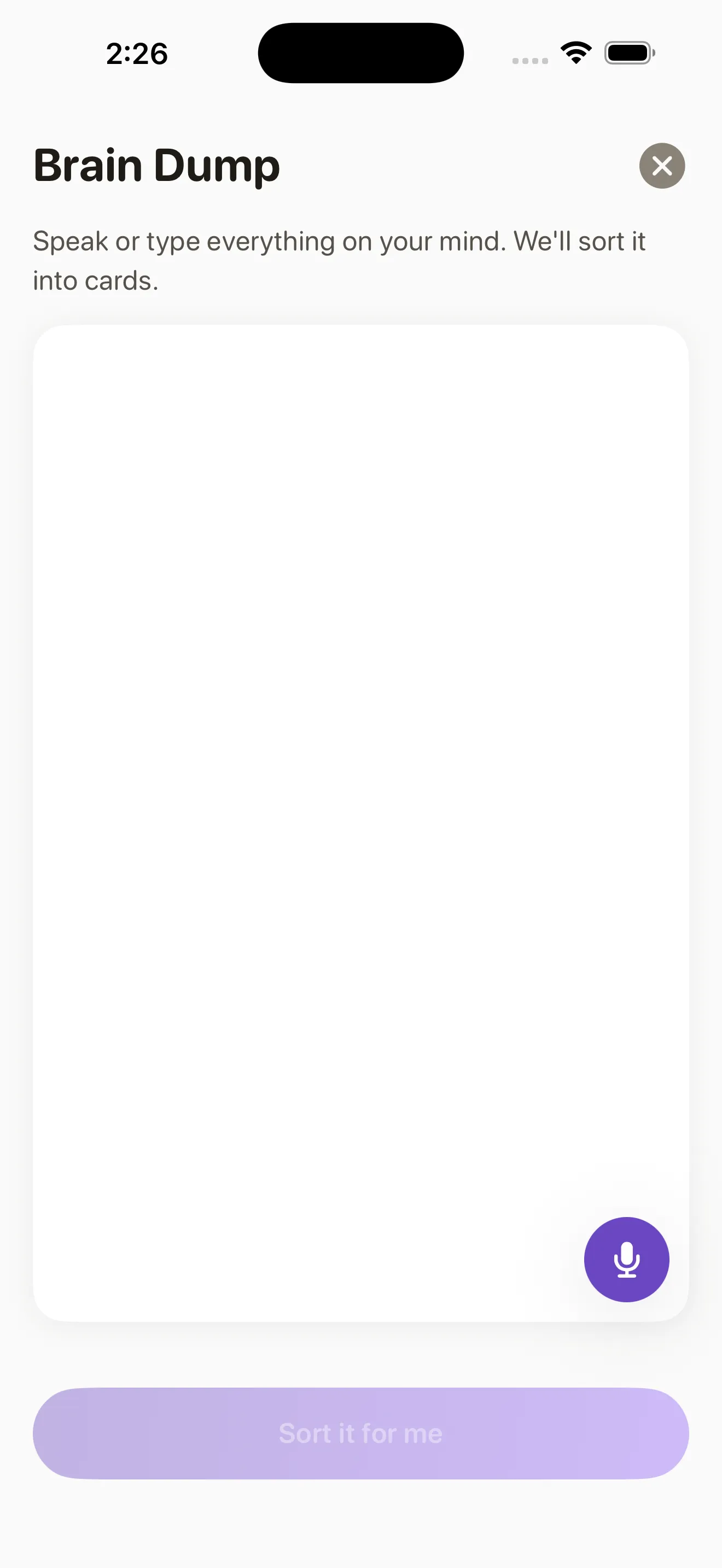
The moment mental load actually gets created is invisible by definition — it's the second someone notices the pediatrician appointment needs rescheduling, or that the school form is due Friday. A 2026 survey of 93 mothers found 42% cope with that moment by texting themselves reminders on WhatsApp, more than the number using any dedicated to-do app, and 69% said they're most likely to forget something for themselves before they'd ever forget something for someone else. That's the gap Brain Dump is built to close: capture the half-formed thought the second it appears, before it either gets lost or turns into a mental sticky note only one partner can see.
This is also where platform timing matters. Apple's own Apple Intelligence documentation for iOS 26 describes native features — Reminders auto-categorization, Notes transcription summaries, on-screen-aware Siri — that raise the baseline for what any capture tool should be able to do. Brain Dump is built to sit above that baseline: it doesn't just transcribe a thought, it routes it toward the household card that already owns that domain, so the interception actually connects to CPE ownership instead of dropping into a generic inbox.
Making imbalance visible instead of arguable
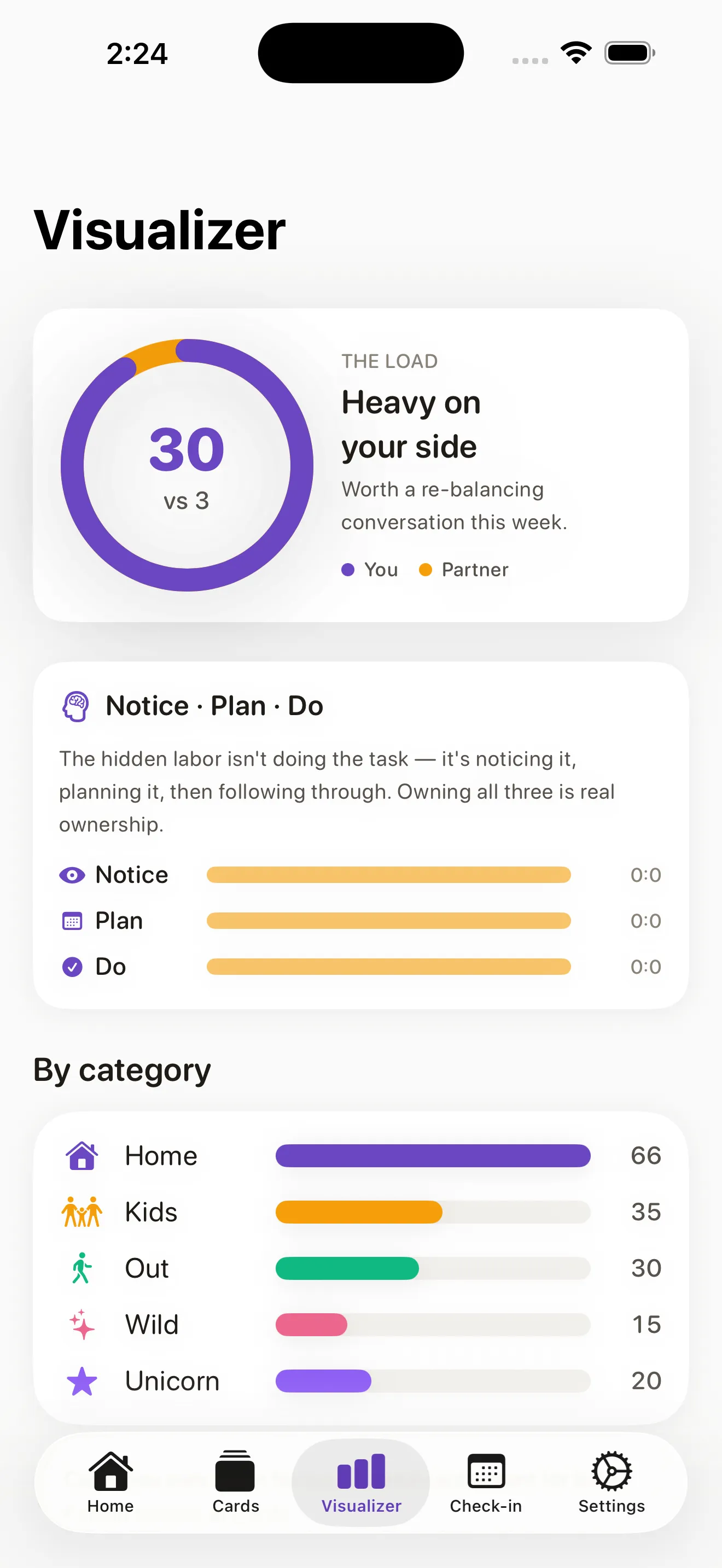
One reason mental load disputes stay circular is that the imbalance is genuinely hard to see from inside it. A widely cited 2018 figure still referenced in 2026 roundups shows the perception gap in stark terms: 52% of men believe household work is split equally, versus just 6% of women who agree. Nobody wins that argument with vibes. FairShare's Visualizer exists to replace the argument with a picture — a breakdown of who holds which cards, across which domains, updated as ownership shifts rather than reconstructed from memory during a fight.
Weekly check-ins: renegotiating before the blow-up, not after
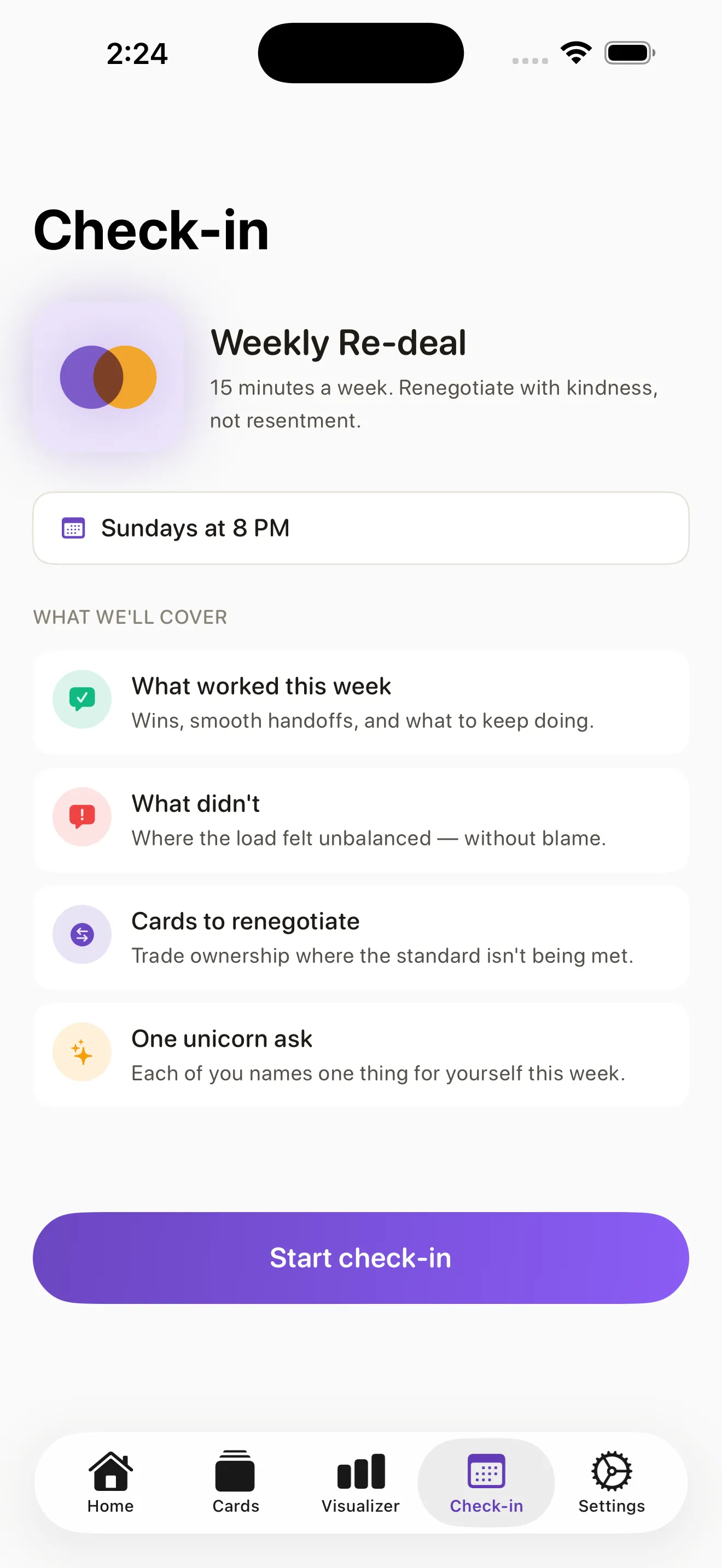
Fair Play calls its renegotiation ritual a redeal, and it's one of the parts of the original system that even its harshest 2026 critics don't dispute — the problem was never the idea of renegotiating, it was the friction of doing it with a physical deck. FairShare's weekly check-ins are a short, structured rhythm: what shifted this week, what needs to swap, whether the minimum standard of care on a card needs updating, and whether anything needs renegotiating — all before it curdles into a fight. It's the same diagnostic instinct behind Fair Play's redeal, minus the overhead the 2026 critique flags as the reason couples quit.
Setting up a household without either partner opting out
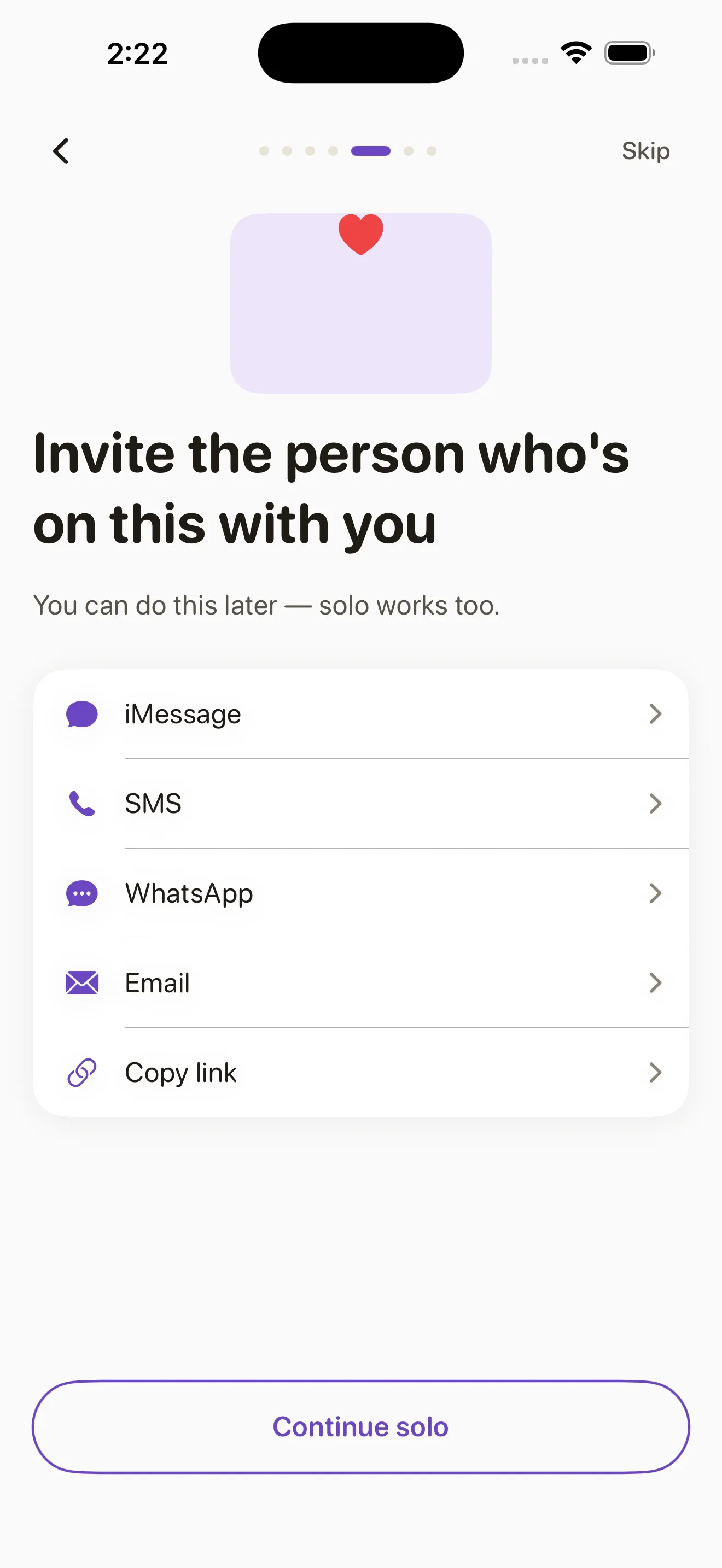
The other top reason couples abandon a system like this, per that same 2026 analysis, is simple: one partner never engages with it at all. FairShare's onboarding leans on household types and a First Deal to get both people into the same picture from day one, and invite links use universal links (https://culi.app/apps/fairshare/join?token=) that open the app directly if it's installed, falling back to a Safari page with Smart Banner parity and a fairshare://join deep link otherwise — so the invite doesn't stall out just because one partner hasn't downloaded the app yet. We break down the mechanics of that in how to invite your partner to a household app.
Common questions
Is FairShare based on the Fair Play method?
What's the difference between a chore app and a mental load app?
Does splitting mental load actually improve wellbeing, or just fairness?
Sources
This article was drafted with AI assistance and reviewed by a human editor before publishing.